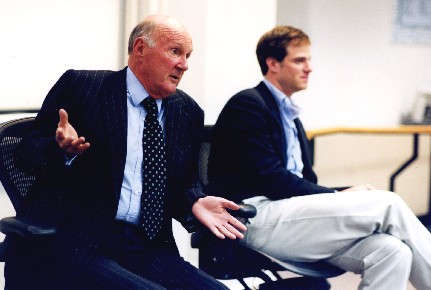
Julian Robertson was not a trend follower. He was, however, a macro trader who often rode the same worldwide trends as trend followers, identifying large directional opportunities in currencies, equities, and commodities through fundamental research rather than systematic price signals. The turtletrader.com view is that his reliance on fundamentals may have contributed to his early retirement, because fundamentals eventually led him to resist a trend he could not rationalize rather than follow the price wherever it went. That tension, between what a market should do and what it is doing, is precisely what systematic trend following is designed to eliminate.
Robertson was nevertheless a primary force in creating and building the hedge fund industry. His founding of Tiger Management in 1980 with $8 million in capital, growing it to $22 billion by the late 1990s, and then generating an entire generation of successful fund managers known as the Tiger Cubs, represents one of the most consequential careers in modern finance. The industry he helped build is the same industry in which systematic trend followers operate today.
Tiger Management: From $8 Million to $22 Billion
Tiger Management started in 1980 and became, by 1997, the second-largest hedge fund in the world with over $10 billion in assets. Robertson’s approach combined deep fundamental research with concentrated positions and a long/short structure that allowed him to profit from both rising and falling stocks. His average annual return of approximately 31.7 percent from 1980 to 1998 placed him comfortably alongside George Soros and other great macro traders of his generation, and significantly ahead of the S&P 500, which returned about 12.7 percent annually over the same period.
His method was built on exhaustive research leading to high-conviction bets. He summarized it himself: “Smart idea, grounded on exhaustive research, followed by a big bet.” The concentrated positioning philosophy, knowing something thoroughly and then sizing the bet to match the conviction, is a principle that runs through the best traders in every methodology. Paul Tudor Jones applied it to macro. Paul Rabar applied it to systematic futures. Robertson applied it to equity fundamentals. The form differs. The principle is the same.
The Dot-Com Collapse and Robertson’s Exit
In the late 1990s, Tiger ran into a problem that the systematic approach is specifically designed to avoid. Robertson looked at the technology stocks driving the dot-com boom and concluded they were an irrational Ponzi scheme, trading at multiples that could not be justified by any fundamental analysis. He was correct in his assessment. The bubble did eventually collapse. But in refusing to participate in a trend he could not rationalize, Tiger fell sharply behind in 1998 and 1999 while the technology mania continued. The fund lost 4 percent in 1998 and 19 percent in 1999, while markets driven by technology were producing large gains. AUM fell from $22 billion to under $7 billion as investors redeemed.
In March 2000, Robertson closed Tiger Management and returned all outside capital. His letter to investors was direct: he saw no reason to continue “subjecting to risk in a market which I frankly do not understand.” He closed at precisely the wrong moment for that decision to look bad and the right moment for his fundamentals thesis to be vindicated. The dot-com crash began almost immediately after. Robertson’s analysis was correct. His timing relative to his investors was catastrophic. A systematic trend following system has no opinion about whether a trend is rational. It follows the price signal and exits when the signal ends. Robertson’s willingness to fight a trend he considered irrational rather than follow it until it reversed illustrates exactly the limitation that systematic approaches are designed to overcome.
Lee S. Ainslie III and the Tiger Cubs
Lee S. Ainslie III Robertson can take pride, however, not only in the accomplishments of those he mentored but also in the continued mentoring of young people by those he trained. Bills and Griffin were once Tiger cubs. Now they are successfully mentoring another generation… Fortune:
So I’m traveling to Charlottesville, Va., with hedge fund legend Julian Robertson and a couple of the other superheroes in the business, all on Air Tiger, Robertson’s Gulfstream II (it’s easy to spot at LaGuardia, by the way–his is the only one with black and orange stripes painted on the tail). The occasion: the dedication of a room in Robertson’s name at U.Va.’s McIntire School of Commerce, along with a forum on hedge funds. On the Gulfstream are John Griffin (who runs Blue Ridge Capital and was once Julian’s right-hand man at Tiger Management) and a handful of other young Wall Street hotshots–such as econ whiz Leah Modigliani of Morgan Stanley–as well as Robertson and his wife, Josie. (At one point I wonder whether Mr. and Mrs. Robertson have ever been referred to as Josie and the Pussycat.)
You probably remember that Robertson, 68, very publicly returned his investors’ money back in March. After a couple of years of under-performance, his funds, which had once held some $21 billion, had shrunk to less than $7 billion. Robertson called the mania over Internet stocks an inadvertent Ponzi scheme, saying to me, The irony of my situation is that I’m leaving just when my game is coming back in style (see Street Life in the fortune.com archive). You called it, Julian! As of Dec. 8, the Nasdaq is down 29.3% for the year, while Robertson, who still runs many millions of his own money, is up modestly, mostly on the strength of his holdings in US Airways.
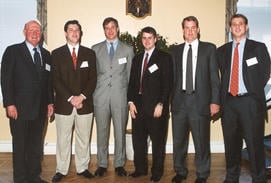
Robertson is a North Carolinian and a faithful graduate of Chapel Hill. So why is he collecting honors at the university one state to the north? Turns out John Griffin–one of Robertson’s early hires at Tiger–is a U.Va. alum, and he brought in bunches of Virginia grads, some of whom went on to form their own hedge funds, including Lee S. Ainslie III, who now runs the $6 billion Maverick Capital. (Some say Robertson would have been wise to groom one of these so-called Tiger cubs as his successor.) Last year Griffin organized an effort to honor their mentor by raising close to $1 million to construct a state-of-the-art trading room at McIntire, the university’s undergrad business school.
In what seems like minutes, we land in Wahoo-land. Griffin takes us for a quick tour of the fabulous (Robertson’s pet superlative) countryside, passing by the homes–estates!–of Edgar Bronfman of Seagram and Halsey Minor, founder of CNET. (John Kluge’s place is on the other side of town.) After that it’s on to the campus for a quick tour of Mr. Jefferson’s university, which is pretty dang interesting. Before we know it, we’re popping over to McIntire to dedicate the Julian H. Robertson Jr. Capital Markets Room, which resembles a miniature version of Salomon’s trading floor, replete with high-end flat-screen monitors, tickers, and such. In his brief remarks, Robertson thanks his proteges and the school, then gives his assessment of the current market: Will the excesses of speculation on high-multiple stocks and mania investing result in a total collapse of all equities? Or will mania and speculation continue to fuel the high multiples? I think the answer to both questions is a resounding no….I see some sort of equilibrium being reached, with the ultra-high-multiple and mania companies coming down in valuation and the other growth stocks, even some of the well-managed old-economy stocks, appreciating. This is a soft-landing theory–probably the best scenario we can hope for. Amen, brother!
The next morning is a hedge fund symposium, again the brainchild of Griffin. The first panel is made up of Robertson, Griffin, Ainslie, and another U.Va. grad, Paul Tudor Jones II, who runs Tudor Investment Corp., one of the largest hedge funds in the world. The press-shy Tudor Jones, who as a globally minded macro investor will go after almost any investment opportunity, spoke pointedly and unequivocally. If there was one sector in the world I could short, it would be the private-equity business in the U.S., he said. (You can, added another panelist. They’re called CMGI and ICG.)
Then all the hedgies were asked for their best investment idea. I would go long on Target, which has better same-store sales and better fashion sense than Wal-Mart, yet is selling at half the valuation, said Ainslie. Kmart, despite what you see on TV, is slowly but surely going out of business. Jones: I would buy two-year notes. I think Nasdaq will go to 2000 [it was 3032 at that point], and the Fed will cut interest rates. As for Griffin: Run, don’t walk, from over-leveraged telcos. Someone thought that if they built a network, they would come. Well, now they have a $10 billion network, and there’s a bandwidth glut.
Finally, Robertson: I like Samsung at four times earnings, he said. It is the world’s lowest-cost producer of liquid-crystal display, the second-largest producer of DRAM chips, and the fastest-growing major maker of cell phones in the world. One final prediction from the master: Hedge funds will have their best relative performance in years, he said. Which makes you think–if Robertson had stayed the course this year instead of folding in March, Tiger would still be on the prowl.
The Tiger Cubs
Why Robertson Matters to the Trend Following World
The Fortune article above is a document of a specific moment; the dot-com bust, the vindication of value investors like Robertson, and the gathering of the hedge fund establishment at a University of Virginia trading room. But it captures something more permanent: the way that exceptional practitioners create ecosystems rather than just track records.
Robertson’s Tiger Cubs — Griffin’s Blue Ridge Capital, Ainslie’s Maverick Capital, and a dozen others went on to manage tens of billions of dollars. Paul Tudor Jones attended the same forum. The overlap between Robertson’s world and the trend following world is not one of method — Robertson used fundamentals, trend followers use price — but of shared conviction that markets can be understood, that discipline produces returns, and that the best traders build their edge through preparation and then execute without hesitation.
Robertson’s call on the dot-com bubble, “an inadvertent Ponzi scheme”, is itself a form of trend following logic applied through a fundamental lens. He saw that the structural valuation of internet stocks had detached from any defensible reality. That is the same observation a trend follower makes when a price breaks below its long-term average: the market has been running on a story rather than on evidence, and the story is ending. Robertson made that call and exited. The trend followers who were short the Nasdaq in 2000 made the same call through price signals. Both were right. Both got there through disciplined analysis rather than hope.
Frequently Asked Questions About Julian Robertson and the Tiger Cubs
Who is Julian Robertson?
Julian Robertson is an American hedge fund manager who founded Tiger Management in 1980. He built it from $8 million to over $21 billion under management before closing it in March 2000, just as his fundamentals-based approach was being vindicated by the dot-com collapse. He is known both for his own performance and for the generation of successful fund managers — the Tiger Cubs — who trained under him.
Who are the Tiger Cubs?
The Tiger Cubs are former Tiger Management analysts who left to found their own hedge funds. Notable examples include John Griffin (Blue Ridge Capital), Lee S. Ainslie III (Maverick Capital), and a number of others who together managed tens of billions of dollars. They share a common analytical foundation rooted in Robertson’s approach to fundamental research and long-short equity investing.
Was Julian Robertson a trend follower?
Robertson was a fundamental macro investor, not a systematic trend follower. His approach was built on deep analysis of companies, sectors, and global economies rather than price signals. However, as TurtleTrader notes, he rode the same worldwide trends as trend followers; his positions in currencies and macro themes aligned with what price-based systems would have identified. The tools differed; the market exposure was similar.
What was Tiger Management?
Tiger Management was Robertson’s hedge fund, founded in 1980 and closed in 2000. At its peak it was one of the largest hedge funds in the world with over $21 billion under management. It produced strong returns through the 1980s and 1990s using a long-short fundamental equity approach. Robertson closed it after two years of underperformance during the late-1990s technology bubble, when momentum in overvalued internet stocks ran counter to his value-based framework.
Want to learn more and start trading trend following systems?
Start here