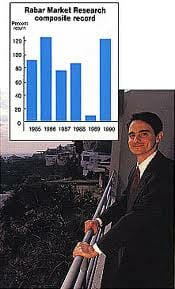
Paul Rabar is one of the most singular figures to emerge from the Turtle experiment. Among a group defined by its diversity, he stood out from the start: a classically trained pianist who had walked away from UCLA medical school, entered the trading world through E.F. Hutton, and then landed in a room with Richard Dennis answering trick questions about corn. That sequence alone sets him apart. But what Rabar built in the decades after his Turtle training, and how he built it, reveals something deeper about what the experiment produced and what it did not.
The Turtle program was designed to settle a bet. Richard Dennis believed traders could be taught. His partner William Eckhardt was skeptical. Dennis won that argument, but the results were never uniform. Some Turtles followed the rules precisely and produced extraordinary returns. Others modified, adapted, or eventually abandoned the framework. Rabar belonged to a third category: someone who absorbed the core of trend following deeply enough that he could run with it independently, at scale, for decades, even as he put his own stamp on how the system operated.
From Medicine and Music to the Trading Floor
Rabar’s path to trading was anything but linear. He had pursued medicine seriously enough to enroll at UCLA’s medical school, only to leave. The details of that decision are less important than what the decision reveals: a willingness to abandon a prestigious, structured path when something else called more clearly. That quality, the capacity to cut losses and change direction without sentimentality, turns out to be foundational to trend following.
His musical training mattered too, though not in the way that is sometimes romanticized. Classical performance at a high level demands a particular relationship with rules. You internalize a structure completely, not to be imprisoned by it, but to execute within it with enough mastery that deviation becomes meaningful. Rabar would later apply exactly that dynamic to trading systems: follow the rules until you understand them well enough to know when a modification earns its keep.
Before Dennis, Rabar worked at E.F. Hutton under Chuck Le Beau, who gave him his first real exposure to systematic trading. That apprenticeship grounded him in the mechanics before Dennis gave him the philosophy. When he arrived for the Turtle interview, he was already a more formed thinker about markets than most of the candidates in the room.
The Interview, the Trick Question, and What Dennis Was Really Looking For
The Turtle selection process was not a standard job interview. Dennis was probing for something specific: the psychological capacity to follow a system under pressure, to hold a losing trade, to add to a winner, to resist the narratives that markets generate. The trick question Rabar encountered during his interview, about whether to “buy it again,” was a test of that orientation. The right answer required overriding instinctive caution and trusting the signal over the feeling.
Rabar got it right. But Dennis’s comment afterward, that he did not want a room full of Rabars, speaks to something worth sitting with. Rabar was exceptional, perhaps too exceptional in certain ways. His intelligence and independence, the same qualities that made him effective, also meant he was unlikely to be a pure rule-follower in the mold Dennis ideally wanted. Dennis wanted people who would execute. Rabar was someone who would eventually need to build his own system.
That tension between following and innovating runs through the entire history of the Turtles. Jerry Parker stayed close to the original framework and built Chesapeake Capital into one of the most consistent trend following operations in the world. Others drifted further. Rabar landed somewhere in the middle: disciplined enough to maintain the core logic, independent enough to modify the execution.
The Billionaire Boys Club and Early Market Exposure
Rabar’s connection to the Billionaire Boys Club is a footnote in his biography but an instructive one. The BBC was a California investment group that collapsed into fraud and murder in the mid-1980s. Rabar was not involved in anything criminal, but his proximity to that world during his formative years in Los Angeles placed him inside a particular culture of aggressive, leveraged, fast-money ambition. That context makes his eventual commitment to systematic, rules-based trading more striking. He saw what unanchored speculation looked like from the inside and chose a different path.
After the Turtles: Airport Meetings and the One-Man Road Show
When the Turtle program ended, Rabar did not join an existing firm or take a comfortable seat at someone else’s table. He went out on his own, running what he described as a one-man road show. The pitch was direct, almost blunt: give me money, no questions. That confidence was not arrogance for its own sake. It reflected a genuine belief in his process and a clear-eyed understanding that institutional investors who needed to understand every detail of a systematic strategy before committing were probably not the right partners.
The airport meetings became a recurring image from that period: Rabar moving through terminals, making his case to potential investors in transit, building an operation through sheer relentless effort. It was a style of capital-raising that demanded belief in yourself before you could ask anyone else to believe in you. Some interpreted that confidence as arrogance. The distinction mattered less than the results.
By 1989, Rabar was ranked fifth in the Wall Street Journal’s performance rankings with an average annual return of 89.1 percent. That figure placed him among the elite systematic traders of his generation and established the credibility that would allow him to scale Rabar Market Research into a serious institutional operation.
Building Rabar Market Research: Architecture of a Trend Following Machine
What Rabar built at Rabar Market Research reflected his particular synthesis of the Turtle methodology with his own thinking about risk and market behavior. The firm operated as a long-term trend following operation, relying on computers to generate the majority of its trading signals. The logic was familiar to anyone who had studied the Turtle rules: identify a trend, enter when the breakout confirms, manage position size through systematic risk limits, exit when the trend ends.
But the implementation had Rabar’s fingerprints on it. Some of the computer-generated orders were modified by Rabar himself, a discretionary overlay on a systematic foundation. This kind of hybrid approach is controversial in the trend following world. Purists argue that any discretionary intervention is a vulnerability, a gap through which cognitive bias can enter and damage returns. Rabar’s position was more nuanced: the system generates the framework, but a manager who understands the system deeply enough can sometimes improve on it at the margin.
The firm also built what Rabar described as a four-level risk management structure. This kind of layered approach to position limits, firm-wide exposure, market-level concentration, and individual trade size reflects sophisticated institutional thinking about how disasters actually happen. Most large trading losses do not come from a single bad trade. They come from correlated exposures that are not visible at the individual position level until a shock hits. Rabar’s framework was designed to make those correlations visible and to limit them before they became catastrophic.
Extensive diversification reinforced the risk architecture. By spreading exposure across a large number of uncorrelated markets, the firm reduced its dependence on any single trade or sector performing well. This is the core logic behind managed futures as an asset class, and it is why managed futures have historically provided portfolio diversification that stock and bond allocations cannot.
The Contrarian Frame and Zero-Sum Thinking
Rabar’s worldview has a distinctive philosophical underpinning. His approach to markets is explicitly contrarian: he looks for situations where consensus thinking is wrong, where the crowd is leaning too hard in one direction, where the price signal contradicts the prevailing narrative. This is not contrarianism for its own sake. It is a recognition that markets are zero-sum over short time horizons, and that sustainable edge requires being right when others are wrong.
The zero-sum framing is important and underappreciated. Most retail investors and many professionals think of trading as a positive-sum activity, something like a business where hard work and insight reliably produce returns. The zero-sum reality is starker: every dollar of profit comes from someone else’s loss. That means consistent profitability requires not just good analysis but a systematic advantage over the counterparties on the other side of your trades. Trend following provides that advantage by exploiting the behavioral biases of discretionary participants who hold losers too long and exit winners too early.
George Soros articulated a related idea through his theory of reflexivity: markets are shaped by the beliefs of participants, those beliefs are often wrong, and the gap between belief and reality creates exploitable inefficiencies. Rabar’s contrarianism draws on similar terrain, though his implementation is systematic where Soros’s is intuitive.
1993, Approaching a Billion, and the Second Generation
By 1993, Rabar was up 49.3 percent, another strong year in a track record that had already established him among the top tier of systematic managers. As Michael Covel reported in interviews conducted while researching The Complete TurtleTrader, Rabar’s assets under management were approaching one billion dollars by the time those conversations took place. That scale placed Rabar Market Research in a different category than most of the original Turtles, who tended to manage smaller, more nimble operations.
The firm’s reach extended beyond its own trading. Jeff Izenman, a second-generation Turtle who trained under Rabar, carried the methodology forward into his own career. This kind of transmission, from Dennis to Rabar to Izenman, is how trading knowledge actually propagates. It is not through textbooks or classrooms but through apprenticeship, observation, and the slow accumulation of experience under the guidance of someone who has already made the mistakes. Dennis understood this when he designed the Turtle program. Rabar demonstrated it by producing a trader capable of building his own operation.
What Rabar Tells Us About the Turtle Experiment’s Real Legacy
The standard narrative of the Turtle experiment focuses on whether Dennis won the bet: could trading be taught? The evidence suggests yes, with qualifications. But the more interesting question is what happened to the knowledge after the program ended. The Turtles dispersed. Some succeeded spectacularly. Some struggled. Some built institutions. Some built quiet operations that persisted for decades without much public attention.
Rabar represents the strand of that legacy that combined institutional ambition with philosophical depth. He was not content to be a faithful executor of the original rules. He built a firm, developed a distinct voice about markets and risk, and produced a second generation of practitioners. That is closer to what Dennis himself did, not just trade well but create a framework that others could inhabit and extend.
The Turtle students as a group are sometimes discussed as if they were interchangeable, all running the same strategy from the same playbook. Rabar’s career disproves that. The shared foundation of trend following, breakouts, risk management, and diversification is necessary but not sufficient to explain the variation in outcomes. The individuals matter. Their judgment about when to follow the system exactly and when to apply their own thinking, their willingness to go out and raise capital alone, their capacity to build institutions and transmit knowledge, those are the variables that separate the Turtles who built lasting operations from those who did not.
Frequently Asked Questions
Who is Paul Rabar?
Paul Rabar is a professional trader and hedge fund manager who was selected by Richard Dennis for the original Turtle trading experiment in the 1980s. He went on to found Rabar Market Research, a trend following commodity trading advisor that managed close to one billion dollars at its peak.
What is Rabar Market Research?
Rabar Market Research is the trading firm Paul Rabar founded after leaving the Turtle program. It operates as a systematic trend following manager with a four-level risk management structure, computer-generated trading signals, and extensive market diversification.
How did Paul Rabar perform as a Turtle?
Rabar was among the top-performing Turtles. By 1989 he ranked fifth in the Wall Street Journal’s performance rankings with an 89.1 percent average annual return. In 1993 he was up 49.3 percent, consistent with his reputation as one of the most successful graduates of the Turtle program.
What was the trick question Richard Dennis asked Paul Rabar?
During the Turtle interview process, Dennis posed questions designed to test whether candidates would trust a systematic signal over their own fear of loss. One involved whether to re-enter a market after a losing trade. Rabar answered correctly, demonstrating the psychological orientation Dennis was looking for, though Dennis noted afterward that he did not want everyone in the group thinking exactly like Rabar.
What is a second-generation Turtle?
A second-generation Turtle is someone who trained under one of the original Turtles rather than under Richard Dennis directly. Jeff Izenman, who trained under Rabar, is among the best-known examples. The knowledge of trend following has propagated through these subsequent generations in much the same way Dennis originally transmitted it to the first group.
Is Paul Rabar still trading?
Rabar Market Research has operated as a registered commodity trading advisor for decades. For current information about the firm’s status and performance, consult NFA registration records or the firm directly.
TurtleTrader is Michael Covel’s site. So is TrendFollowing.com.
That’s where you’ll find his trading systems, courses, 1,400+ podcast episodes and much more.