
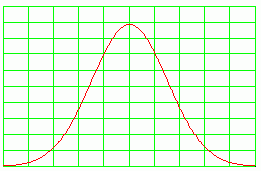

Michael Mauboussin offers clarity on outliers in trading. While Mauboussin concludes standard finance theory has little to say on the subject, we note trend followers regularly hunt and win outliers in the trading game.
Bell Curve and Outliers
Full House The Spread of Excellence From Plato to Darwin
Why Trend Following Lives in the Tails
Standard finance theory is built on the normal distribution: the bell curve. The bell curve places the overwhelming majority of outcomes near the average and treats extreme outcomes as exponentially rare. Under this framework, a five-standard-deviation price move should occur roughly once every several thousand years. In actual markets, such moves occur multiple times per decade. The tails are fat. The bell curve is wrong about them.
Mauboussin’s observation that standard finance theory has little to say about outliers is the honest acknowledgment of the bell curve’s failure. Portfolio management, risk models, value-at-risk calculations, options pricing, and correlation assumptions are all built on a framework that systematically underestimates the frequency and magnitude of extreme events. This is why institutions that rely on those models are repeatedly destroyed by events the models labeled nearly impossible.
Trend following is the approach specifically designed to profit from fat tail events rather than be destroyed by them. The mechanism is direct: trend following holds positions that are moving strongly in one direction and exits positions that have reversed. Large, sustained price movements, which are the fat tail events in market price distributions, are precisely the events that produce trend following’s largest returns. The system does not need to predict when a fat tail event will arrive. It enters when the large movement begins to develop and holds through it for as long as it continues.
The position sizing approach that trend following uses, setting each position size so that it represents a defined, small percentage of account equity, ensures that the system is sized to participate in fat tail events without being destroyed by the occasional adverse fat tail. A position sized at 1-2% of equity cannot destroy the account regardless of how far it moves against the holder. But a position held in the direction of a large sustained move, sized consistently and held through the full extent of the trend, can produce returns of many multiples of the initial risk. This asymmetry is the structural source of trend following’s edge: defined, small losses on the many failed breakout entries, and occasional very large gains when a fat tail event produces a sustained trend.
Mauboussin’s reference materials, the bell curve comparison and Gould’s Full House, both address the same underlying point: extreme events are not anomalies to be explained away. They are structural features of complex systems. In biological evolution, in baseball statistics, and in financial markets, the extreme outcomes are not deviations from the normal case. They are the signal, while the average cases are the noise. Trend following is the trading approach that reads the signal.
Frequently Asked Questions
What are fat tails in financial markets?
Fat tails refer to the statistical reality that extreme price movements occur far more frequently than the normal distribution predicts. A bell curve assigns near-zero probability to five-standard-deviation moves. In financial markets, such moves occur regularly. The tails of the actual price distribution are “fat” — heavier than the bell curve allows. Any risk model built on the normal distribution systematically underestimates the probability and magnitude of these extreme events.
Why does standard finance theory fail to address fat tail events?
Because standard finance theory is built on the normal distribution, which describes how random variables behave when they result from the sum of many independent small influences. Financial prices are not generated by that process. They are generated by the interactions of millions of participants responding to each other, to news, and to price itself. This produces a distribution with fat tails that the bell curve cannot model correctly. Standard theory has few tools for environments where the tail events are the ones that matter most.
How does trend following profit from fat tail events?
By being positioned in the direction of large sustained price movements when they occur. A fat tail event in price terms is a large, sustained move in one direction. Trend following enters when a price movement exceeds a defined threshold and holds the position as long as the movement continues. The small losses from entries that fail to develop into fat tail events are the cost of being positioned when the fat tail arrives. The occasional fat tail event produces returns large enough to more than offset all the small losses combined.
Trend Following Systems
Want to learn more and start trading trend following systems? Start here.
