What Is the TurtleTrader Story?
The TurtleTrader story is the true account of how legendary Chicago trader Richard Dennis took 23 complete beginners, taught them his trend following system in two weeks, and watched them generate over $100 million in profits. It is the most famous real-world test of whether great trading is a born talent or a learnable skill. Dennis believed it could be learned. His partner William Eckhardt disagreed. The TurtleTrader experiment settled the argument permanently.
This is the story of how a group of ragtag students, many with no Wall Street experience, were trained to be millionaire traders (PDF). Think of Donald Trump’s show The Apprentice, played out in the real world with real money and real hiring and firing. However, these apprentices were thrown into the fire and challenged to make money almost immediately, with millions at stake. They were not trying to sell ice cream on the streets of New York City. They were trading stocks, bonds, currencies, oil, and dozens of other markets to make millions.
This story blows the roof off the conventional Wall Street success image so carefully crafted in popular culture: prestige, connections, and no place at the table for the little guy to beat the market. Legendary investor Benjamin Graham always said that analysts and fund managers as a whole could not beat the market because in a significant sense they were the market.
On top of that, the academic community has argued for decades about efficient markets, once again implying there is no way to beat market averages. Yet making big money and beating the market is doable if you do not follow the herd and think outside the box. People do have a chance to win in the market game, but they need the right rules and attitude to play by. And those right rules and attitude collide head-on with basic human nature.
How the TurtleTrader Story Was First Discovered
This real-life apprentice story would still be buried had Michael Covel not randomly picked up the July 1994 issue of Financial World magazine. On the cover was famed money manager George Soros playing chess. Soros had made $1.1 billion for the year. The article listed the top one hundred paid players on Wall Street for 1993. Julian Robertson was second at $500 million. Bruce Kovner was fifth at $200 million. Henry Kravis of KKR was eleventh at $56 million. Famed traders Louis Bacon and Monroe Trout were on the list too.
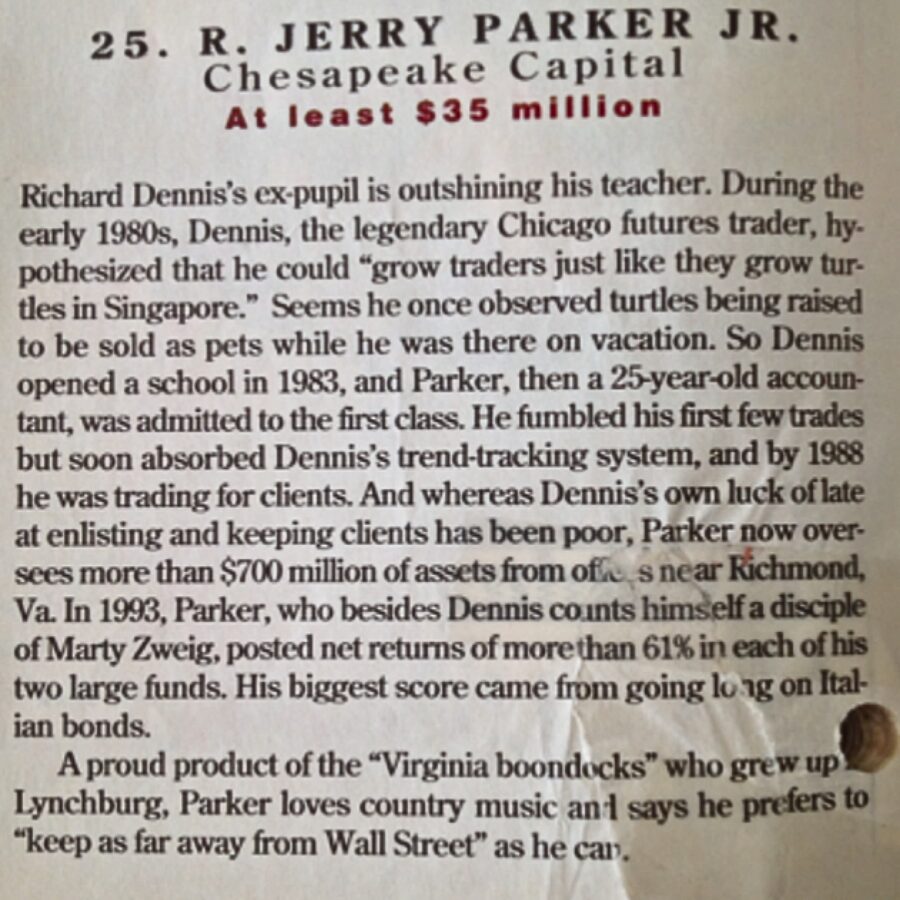
Unexpectedly, one of them just happened to be living and working outside Richmond, Virginia, two hours from Covel’s home. Twenty-fifth on the list was R. Jerry Parker, Jr. of Chesapeake Capital, and he had just made $35 million. Parker was not yet forty years old.
His brief biography described him as a former pupil of Richard Dennis and noted that he was trained to be a “Turtle.” Parker was described as a then twenty-five-year-old accountant who had attended Dennis’s school in 1983 to learn his “trend-tracking system.” Here was a man who bragged that he was a product of the “Virginia boondocks,” loved country music, and preferred to keep as far away from Wall Street as possible.
This was no typical moneymaking story. The common wisdom that the only way to find success was by working in eighty-story steel-and-glass towers in New York, London, Hong Kong, or Dubai was clearly dead wrong. Jerry Parker’s office was absolutely in the middle of nowhere, thirty miles outside Richmond in Manakin-Sabot, Virginia. Seeing Parker’s country office was an electrical impulse — permanently dispelling the importance of location.
Were there more of these students? How did they become students? What were they taught? And who was this man Dennis who had taught Parker and others?
Who Was Richard Dennis and Why Did He Run the Experiment?
Richard Dennis was an iconoclast, a wildcatting Chicago trader not affiliated with a major investment bank or Fortune 500 firm. As the “locals” were fond of saying on Chicago trading floors, Dennis “bet his left nut.” In 1983, by the time he was thirty-seven, he had made hundreds of millions of dollars out of an initial grubstake of a few hundred. Dennis had done it on his own terms in less than fifteen years, with no formal training or guidance from anyone. He took calculated risks, leveraging up huge amounts of money.
If he liked a trade, he took all of it he could get. He lived the markets as a “betting” business. Dennis figured out how to profit in the real world from an understanding of behavioral finance decades before Nobel prizes were handed out to professors preaching theory. His competitors could never get a handle on his consistent ability to exploit irrational market behavior throughout all types of markets.
He felt anyone could learn how to trade if taught properly. His partner, William Eckhardt, disagreed, and their debate resulted in an experiment with a group of would-be apprentice traders recruited during 1983 and 1984 for two trading classes.
That “Turtle” name? It was simply the nickname Dennis used for his students. He had been on a trip to Singapore and visited a turtle-breeding farm. A huge vat of squirming turtles inspired him to say: “We are going to grow traders just like they grow turtles in Singapore.”
After Dennis and Eckhardt taught novices like Jerry Parker how to make millions and the school closed, the experiment morphed into word-of-mouth legend over the years supported by few hard facts. The National Enquirer version of the story was captured in 1989 by a Wall Street Journal headline: “Can the skills of successful trading be learned? Or are they innate, some sort of sixth sense a lucky few are born with?”
Since the 1980s are long past, many might wonder if the TurtleTraders’ story still has relevance. It has more relevance than ever. The philosophy and rules Dennis taught his students are similar to the trading strategy employed by numerous billion-dollar-plus hedge funds today. The effort to get the real story out there started to gain momentum in 2004, when Covel was invited to visit Legg Mason’s headquarters in Baltimore following the release of his first book, Trend Following.
After lunch, Covel found himself in a classroom with Bill Miller, the fund manager of the $18 billion Legg Mason Value Trust fund. Beating the S&P 500 for fifteen years straight put him in a similar league as Warren Buffett. Miller was lecturing a roomful of eager trainees. Out of the blue, Miller invited Covel to the lectern. The first questions came straight from Miller and Michael Mauboussin, then Legg Mason’s chief investment strategist: “Tell us about Richard Dennis and the Turtles.”
At that moment, it was clear that if these two Wall Street pros wanted to know more about Dennis, his experiment, and the TurtleTraders, a much larger audience would want to hear the story.
The Nature vs Nurture Debate: Can Trading Be Taught?
In the early 1980s, when Chicago’s reigning trader king Richard Dennis decided to conduct his real-life social experiment, Wall Street was heating up. The stock market was at the start of a huge bull market. President Reagan had declared it “The Year of the Bible.”
In order to find his special breed of student guinea pigs, Dennis circumvented conventional recruitment methods. His firm, C&D Commodities, budgeted $15,000 for classified ads in the Wall Street Journal, Barron’s, and the International Herald Tribune seeking trainees during late fall 1983 and 1984. Avid job seekers saw this:
Richard J. Dennis of C&D Commodities is accepting applications for the position of Commodity Futures Trader to expand his established group of traders. Mr. Dennis and his associates will train a small group of applicants in his proprietary trading concepts. Successful candidates will then trade solely for Mr. Dennis: they will not be allowed to trade futures for themselves or others. Traders will be paid a percentage of their trading profits, and will be allowed a small draw. Prior experience in trading will be considered, but is not necessary. Applicants should send a brief resume with one sentence giving their reasons for applying to: C&D Commodities 141 W. Jackson, Suite 2313 Chicago, IL 60604 Attn: Dale Dellutri. Applications must be received by October 1, 1984. No telephone calls will be accepted.
Lost in the back pages of national newspapers, the ad attracted surprisingly few respondents when you consider what Dennis was offering. But then, people do not usually expect the road to riches to be in plain sight. The ad invited anyone to join one of Chicago’s most successful trading firms, making experience optional. It was as if the Washington Redskins had advertised open positions regardless of age, weight, or football experience. Perhaps most stunning was that C&D Commodities was going to teach proprietary trading concepts, completely unheard of at the time since great moneymaking trading systems were always kept under lock and key.
Potential students who were ultimately hired recall being stunned. “This can’t be what I think it is” was a common refrain. It was, unbelievably, an invitation to learn at the feet of Chicago’s greatest living trader and then use his money to trade and take a piece of the profits.
Dennis believed that his ability to trade was not a natural gift. He looked at the markets as being like Monopoly. He saw strategies, rules, odds, and numbers as objective and learnable. In Dennis’s book, everything about the markets was teachable, starting with his very first prerequisite: a proper view of money. He did not think about money as merely a means to go buy stuff at the mall, the way most people do. He thought of money as a way to keep score.
Dennis would say, in effect: “If I make $5,000, then I can bet more and potentially make $25,000. And if I make $25,000, I can bet that again to get to $250,000. Once there, I can bet even more and get to a million.” He thought in terms of leverage.
William Eckhardt was solidly rooted in the nature camp. Dennis explained the fundamental debate behind the experiment:
“My partner Bill has been a friend since high school. We have had philosophical disagreements about everything you could imagine. One of these arguments was whether the skills of a successful trader could be reduced to a set of rules, that was my point of view, or whether there was something ineffable, mystical, subjective, or intuitive that made someone a good trader. This argument had been going on for a long time, and I guess I was getting a little frustrated with idle speculation. Finally, I said, ‘Here is a way we can definitely resolve this argument. Let’s hire and train people and see what happens.’ He agreed. It was an intellectual experiment.”
Even though Eckhardt did not believe traders could be nurtured, he had faith in the underdog. He knew plenty of multimillionaires who had started trading with inherited wealth and bombed. Eckhardt saw them lose it all because they did not feel the pain when they were losing:
“You’re much better off going into the market on a shoestring, feeling that you can’t afford to lose. I’d rather bet on somebody starting out with a few thousand dollars than on somebody who came in with millions.”
Who Were the TurtleTrader Students?
Richard Dennis wanted a mishmash of personalities, similar to MTV’s Real World and their diverse casting calls. He selected both far-right-wing conservatives and bleeding-heart liberals. A high school graduate and an MBA were picked from the thousand-plus applicants who threw their hats into the ring. The wild cross-section of his final TurtleTrader picks demonstrated Dennis’s diversity desires.
There were college graduates from the State University of New York at Buffalo (business), Miami University in Ohio (economics), the New England Conservatory of Music (piano, music theory), Ferrum College in Virginia (accounting), Central Connecticut State University (marketing), Brown University (geology), the University of Chicago (PhD in linguistics), Macalester College (history), and the United States Air Force Academy. Others had recently held jobs at a security guard firm, Caterpillar Tractor (salesperson), Collins Commodities (broker), the Ground Round Restaurant (assistant manager), A.G. Becker (phone clerk), Palomino Club (bartender), and Dungeons and Dragons (board game designer).
One student simply declared his status as “unemployed.” Earlier job histories included kitchen worker, teacher, prison counselor, messenger, accounting assistant, and waiter. Dennis selected one woman from the ad, a rarity in the 1980s “all boys” world of Chicago trading. He also selected gay students, whether he knew their orientation at the time or not.
Dennis wanted students who showed a willingness to take calculated risks. Those who stood out from the herd in some unconventional way had a leg up. Think like a Vegas handicapper? You were more likely to get an interview.

In the end, to their detriment, people are always risk-averse toward gains, but risk-seeking toward losses. The average newbie investor’s method for success is not pretty. He gets in because his friends are doing it. Then the news media start up the stories of little guys doing well during a bull market. They all start to “invest” by picking stocks with “low” prices. As the market roars in their favor, thoughts of crashes never enter their mind. They never see their own slaughter coming, even though their market bubble is never different from past ones.
But outside of the herd there are the special few who have the uncanny knack for knowing when to buy and sell, combined with an uncanny knack to properly assess risk. Richard Dennis mastered that uncanny knack by his early twenties. What he learned and what he taught students never resembled Jim Cramer barking stock tips. More importantly, Dennis proved that his ability to make money in the markets was not luck.
Dennis and Eckhardt taught their students everything they needed in only two weeks to trade bonds, currencies, corn, oil, stocks, and all other markets. In the end, a persistent drive for winning combined with a healthy dose of courage would be mandatory for Dennis’s students’ long-term survival.
As author Steve Gabriel wrote on Yahoo! Finance: “The experiment has already been done that shows that we can all learn to trade for a living if we want to. That is why the ‘Turtles’ matter.”
The TurtleTraders are an answer to the age-old question of nature versus nurture, the living proof of the single most famous Wall Street school for making money.
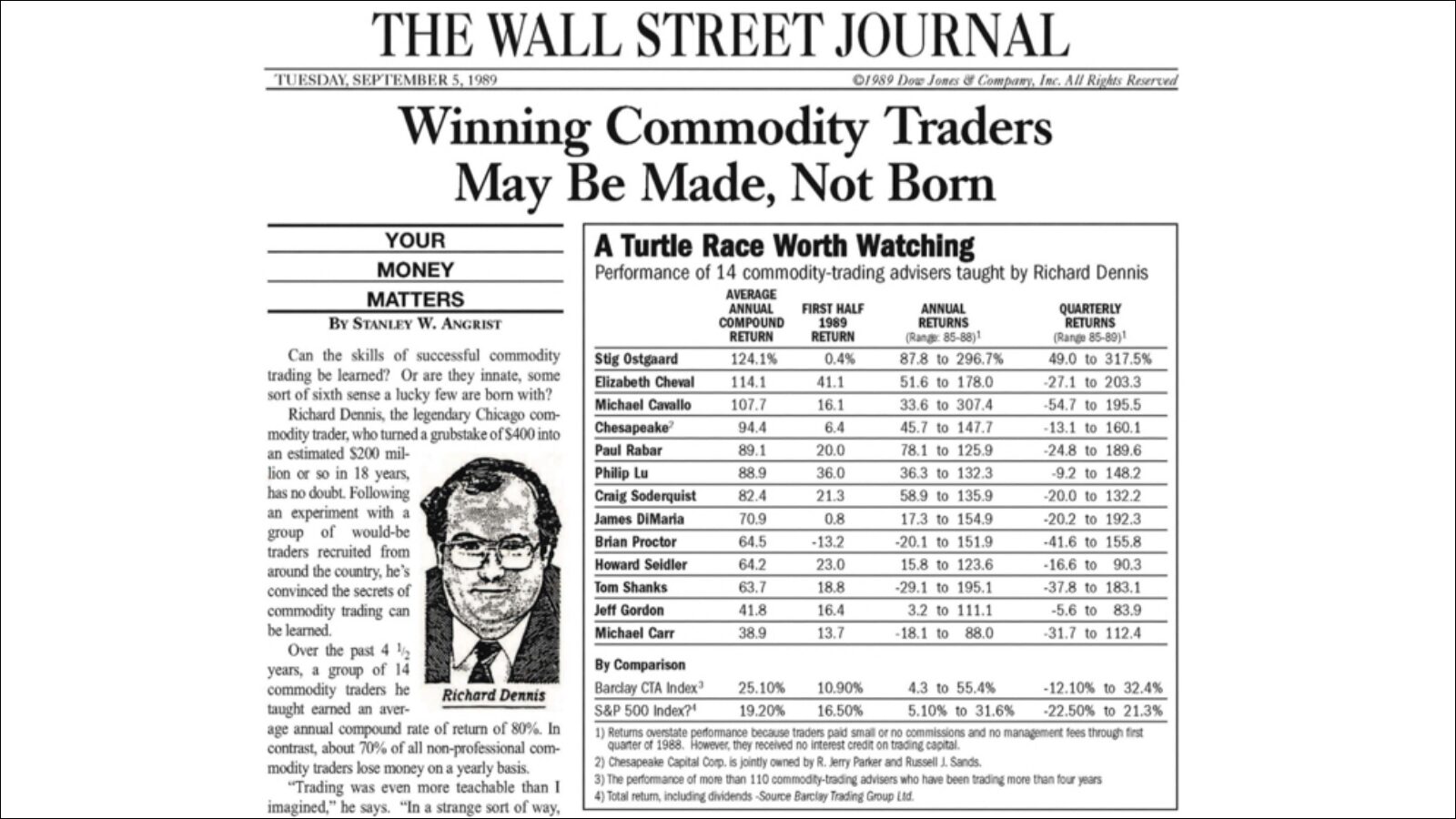
Read the full Wall Street Journal article on the TurtleTrader experiment
Read it all: The Complete TurtleTrader book and subscribe to the podcast.
Frequently Asked Questions About the TurtleTrader Experiment
What was the TurtleTrader experiment?
The TurtleTrader experiment was a real-world test run by Richard Dennis in 1983 to settle a debate with his partner William Eckhardt over whether trading skill could be taught or whether it was an innate talent. Dennis recruited 23 complete beginners, trained them in his trend following rules over two weeks, gave them funded accounts, and watched them generate over $100 million in profits. Dennis won the argument decisively.
Why did Richard Dennis call them Turtles?
Dennis had visited a turtle-breeding farm in Singapore where he watched turtles being grown from nothing into full-sized creatures. He said: “We are going to grow traders just like they grow turtles in Singapore.” The name stuck.
How many TurtleTraders were there?
Dennis selected 23 students across two training classes in 1983 and 1984. They came from wildly different backgrounds including accounting, music, game design, the military, and the legal profession. Most had no prior trading experience.
Did the TurtleTrader experiment prove that trading can be learned?
Yes, conclusively. The group generated over $100 million in profits using the rules Dennis taught them. Jerry Parker, who had been an unknown accountant in rural Virginia, went on to found Chesapeake Capital and manage over $1 billion. The experiment remains the most powerful real-world proof that trading is a learnable skill, not an innate talent.
What rules did the TurtleTraders use?
The TurtleTraders were taught a systematic trend following system. They entered trades when markets hit new price highs or lows, sized their positions based on market volatility, and held winning trades for as long as the trend continued. The full rules are documented on the Rules page.
Who was the most successful TurtleTrader?
Jerry Parker of Chesapeake Capital is widely considered the most successful of all the original TurtleTraders. He turned his training into a decades-long career managing billions using the same principles Dennis taught him in two weeks.
Is the TurtleTrader story still relevant today?
More than ever. The trend following principles Dennis taught the TurtleTraders underpin the strategies of many of the world’s largest and most successful hedge funds. The story of how ordinary people with no financial background were turned into successful traders has never been more powerful as a demonstration that markets can be beaten with the right rules and the right discipline.
Note: TurtleTrader.com® is the only location for the complete TurtleTrader story and rules, online since 1996. Michael Covel’s TurtleTrader efforts span interviews with the most successful TurtleTrader, Jerry Parker, to his bestselling book The Complete TurtleTrader.
Available in: Deutsche | Français | हिंदी | 中国 | 日本語 | Pусский | 한국어 | Italiano | Nederlands | Português | Español
Want to learn the exact rules Richard Dennis taught his TurtleTraders? Read the original TurtleTrader rules