
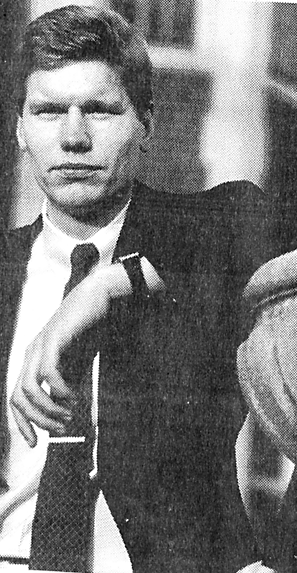
Monroe Trout is an interesting short-term trader. He is a major supporter of the philosophical tenets of Ayn Rand. Many top traders believe deeply in Rand’s teachings for good reason. We recommend a visit to Rand’s site for solid insight.
Here is an excerpt from an interview in The New Market Wizards by Jack Schwager:
Q. When did you first get interested in the markets?
A. When I was 17 yrs. old, I got a job for a futures trader named Vilar Kelly who lived in my hometown of New Canaan, Connecticut. He had an Apple computer, and at the time (1978), you couldn’t buy data on diskette–or at least he didn’t know where to buy it if it was available. He had reams of price data that he had collected from newspapers and wanted typed into his computer. He hired me and paid me a couple of bucks an hour to type in this data. That summer job sparked my interest in the markets. By my sophomore year at Harvard, I knew that I wanted to be a trader. I took whatever courses they had on the markets. I did my senior thesis on the stock index futures market.
The Summer Job That Changed Everything
The image of a seventeen-year-old typing price data from newspaper cuttings into an Apple computer is a precise snapshot of how systematic trading was built by hand, from scratch, in 1978, before commercial data vendors existed. Vilar Kelly was doing what Richard Dennis and William Eckhardt were doing in Chicago at the same time: accumulating price history to test ideas about how markets behave. The infrastructure that now makes systematic trading trivially accessible did not exist. The traders who built the first systems built them with whatever they had.
Trout was not just a data entry clerk that summer. He was absorbing a way of thinking about markets; price as information, patterns as testable hypotheses, a computer as the tool for turning observation into evidence. By his sophomore year at Harvard he knew he would be a trader. By his senior year he was writing an academic thesis on it. The preparation preceded the opportunity by years, which is the pattern that runs through every serious trading career in the Market Wizards literature.
Monroe Trout: The Full Profile
A quick profile of Monroe Trout, Jr.:
Monroe Trout, Jr., born January 22, 1962, is the sole principal of Trout Trading Company. He has traded futures and other contracts as a full-time profession since September 1984, and has been involved in futures market research since 1978. Mr. Trout graduated magna cum laude from Harvard College in 1984 with a B.A. in Economics. While at Harvard, Mr. Trout wrote six major papers about the forecasting of futures and options prices, culminated by his senior honors thesis titled Price movements in a Stock Index Futures Market. From September 1984 until June 1986, Mr. Trout was employed as a futures and options trader by NCZ Commodities, Inc. (NCZ), A Futures Trading Firm run by Victor Niederhoffer. While with NCA, Mr. Trout traded futures for both the house and his own personal accounts. In addition to extensive off-the-floor trading experience, Mr. Trout also has a certain amount of on-the-floor trading experience, having the-floor trading experience, Mr. Trout also has a certain amount of on-the-floor trading experience, having been a member of the Commodity Exchange, Inc. (COMEX), the New York Futures Exchange, and the American Stock Exchange. In July 1986, Mr. Trout left NCZ to establish Trout Trading Company.
Click here to view research sources for Trout’s famous thesis paper.
Six Papers Before Trading a Dollar
The profile above mentions six major papers on the forecasting of futures and options prices, written while Trout was an undergraduate. This is not the biography of someone who stumbled into systematic trading. It is the biography of someone who spent his undergraduate years building and testing models before he ever had real capital to put behind them.
That sequencing, research before capital, is the intellectual foundation of what makes serious systematic traders different from casual market participants. The TurtleTrader rules were not assembled from intuition by Dennis and Eckhardt. They were developed through years of testing, refined through observation, and taught to a group of trainees who were expected to understand the evidence behind every rule they followed. Trout arrived at the same discipline through academic research. The path differed; the destination was the same: a set of testable, evidence-based principles for trading price movements.
Victor Niederhoffer: The First Employer
Trout’s first professional trading role was at NCZ Commodities, a futures trading firm run by Victor Niederhoffer. Niederhoffer is one of the more unconventional figures in the trading world — a Harvard-educated squash champion turned trader who developed a quantitative, contrarian approach to markets and was later profiled as one of the top traders of his era before a catastrophic blow-up in 1997. The two years Trout spent at Niederhoffer’s firm gave him direct exposure to professional futures trading at a time when the systematic approach Trout had studied in his research was being applied in a live market environment.
The Niederhoffer connection also illustrates something important about how trading knowledge spreads. The same network that runs through the Market Wizards books, Commodities Corporation, the Chicago pits, the New York options markets; connected traders who shared information, developed models in parallel, and trained the next generation. Trout moved from that network to build his own firm in 1986, taking with him six years of market research, two years of professional trading experience, and a systematic framework that would define Trout Trading Company’s approach for decades.
Ayn Rand and the Trader’s Mindset
The note that Trout is a major supporter of Ayn Rand’s philosophical tenets is not incidental to his trading career. Rand’s philosophy of rational individualism, the idea that reason, not emotion or social pressure, is the proper guide to action, maps onto the demands of systematic trading. A trend follower who follows a model against the consensus, holds a losing position because the system says to hold, or exits a winning trade because the rules say to exit, is practising the kind of disciplined, evidence-based, emotionally independent decision-making that Rand’s philosophy describes. The alignment between Rand’s ideas and the trader’s mindset is why her work has found a consistent audience in the trading world.
Frequently Asked Questions About Monroe Trout
Who is Monroe Trout?
Monroe Trout Jr. is a futures trader who founded Trout Trading Company in 1986. He graduated magna cum laude from Harvard in 1984 with a degree in Economics, having written six papers on futures and options price forecasting and a senior thesis on stock index futures. He was profiled in The New Market Wizards by Jack Schwager. His career in futures research began at seventeen when he typed price data for a Connecticut futures trader.
What is Trout Trading Company?
Trout Trading Company is the futures and commodities trading firm Trout founded in July 1986 after leaving NCZ Commodities, where he had traded under Victor Niederhoffer. The firm operates as a short-term systematic trading operation. Trout is the sole principal. His approach combines the quantitative research foundation he built at Harvard with the professional trading experience he gained at NCZ.
How does Trout connect to trend following?
Trout is a short-term trader rather than a long-term trend follower, but the intellectual foundations of his approach; systematic models, price-based signals, testable hypotheses, are shared with the trend following world. As TurtleTrader notes, short-term trading at the level Trout operates requires sizable investment in staff, technology, and data access. The TurtleTrader rules apply the same systematic discipline on a longer time horizon, where the infrastructure requirements are more accessible to individual traders.
Why did Trout write a thesis on stock index futures at Harvard?
By his sophomore year at Harvard, Trout had already decided he wanted to be a trader. His summer job typing price data at seventeen had introduced him to the idea that price history could be analysed to find patterns. The thesis was a natural extension of that interest, a formal academic investigation of the price behaviour of stock index futures, building on the six papers he had written on futures and options forecasting during his undergraduate years.
Trend Following Systems
Want to learn more and start trading trend following systems? Start here.
