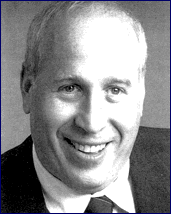
“We approach markets backwards. The first thing we ask is not what can we make, but how much can we lose. We play a defensive game.”
Larry Hite
Former Profession:
I was a rock promoter in college, and on one weekend, there were three separate shootings in clubs at which the groups I managed were working. I decided it was an opportune time to change careers and pursue my true interest–the financial markets. I didn’t have any idea how to look for a job in that field, so I decided I would start out as a stock broker.
More on how Larry Hite got into trading (source: Market Wizards by Jack Schwager)
Q. How did you first get interested in the markets?
A. When I was in college, I took a business course with a professor who had a trenchant sense of humor. To give you an example, he also worked as a bank examiner. One day, before leaving the bank following an audit, he turned to the bank president and, as a joke, said, Got you! The man had a heart attack on the spot. After that, they did another audit and found that the bank president had embezzled $75,000. Anyway, in class one day, this professor is reviewing all the financial instruments: stocks, bonds, and so on. Then he says, Now we come to the craziest market of all–commodities. These people trade on only 5% margin–and most of them borrow that. The whole class laughed, except me. For some reason, the idea of trading on 5% margin made perfect sense to me.
The Rock Promoter Who Built a Billion-Dollar CTA
The origin story is one of the most memorable in the Market Wizards series. Hite was a rock concert promoter whose career ended with three shootings in a single weekend. He pivoted to financial markets with no connections and no training, started as a stockbroker, and worked his way toward commodities because the leverage fascinated him rather than frightened him.
That response to 5% margin is the key detail. The entire class laughed at the idea of trading on minimal capital with borrowed money on top. Hite saw it as an opportunity. He understood intuitively that leverage amplifies the outcome of any edge, and that the question of whether to use leverage is secondary to the question of whether a trading edge exists. If the edge exists, leverage produces returns. If it does not, leverage accelerates the loss. The whole logic of systematic trend following depends on this: the system exists because an edge exists, and the sizing and leverage are calibrated to match the size of that edge to the size of acceptable risk.
The Defensive Game: Risk First, Return Second
Hite’s opening statement, “We approach markets backwards. The first thing we ask is not what can we make, but how much can we lose,” is one of the most quoted lines in trend following literature because it captures the entire risk management philosophy in two sentences.
Most retail investors approach a trade by calculating potential profit first. The upside possibility is what motivates the trade. The downside is considered later, if at all. Hite reversed that order. The starting question was how much capital was at risk if the trade failed. Only after that question was answered would the potential return be considered. The expected return had to justify the defined maximum loss. If it did not, the trade was not taken.
This is the same logic encoded in the TurtleTrader rules. Every entry in the system began with a defined maximum loss. Position size was calculated to ensure that a full adverse move to the stop would cost no more than one N unit of portfolio risk. The potential return was determined by the size and duration of the trend, which was unknown at entry. The loss was defined before the trade began. Hite arrived at the same structure through his own experience and named it the defensive game.
Mint Investment Management: Scale and Consistency
Hite co-founded Mint Investment Management with Peter Matthews. At its peak in the late 1980s, Mint was the largest commodity trading advisor in the world by assets under management, managing over $1 billion. It produced a compounded annual return above 30 percent over the relevant period, making it one of the most successful systematic trading operations of its era.
The same era produced Richard Dennis‘s Turtles, John W. Henry‘s JWH, and a generation of trend following CTAs that demonstrated, across independent firms with independent methods, that systematic price-following produces returns over time. Mint was the largest of those operations and the one that proved the scale argument: the edge does not disappear when the fund grows from ten million to one billion. The returns held because the approach traded a diversified portfolio of global markets where a billion-dollar CTA still represented a small fraction of total market liquidity.
Seeing Risks, Rewards, and Money
Hite’s other famous line, “Frankly, I don’t see markets; I see risks, rewards, and money,” is a description of how systematic trading reframes the question of what a market is. A discretionary trader sees a market as a specific asset with specific characteristics: wheat, yen, crude oil. A systematic trend follower sees a market as a vehicle for expressing a risk-reward relationship. The asset class is secondary. The question is whether the risk is worth taking given the defined maximum loss and the expected return from following the trend.
That abstraction is what allows Mint and similar firms to trade dozens of markets with the same approach. The system does not care whether it is trading currencies or commodities. It cares whether the price is trending and whether the risk-reward relationship of the current signal meets the criteria. Hite’s framing of markets as risks, rewards, and money is not poetic. It is the operational description of how systematic trend following works.
Frequently Asked Questions About Larry Hite
Who is Larry Hite?
Larry Hite is a trend following trader who co-founded Mint Investment Management with Peter Matthews. He was profiled in Market Wizards by Jack Schwager. Before trading, he worked as a rock concert promoter and later as a stockbroker. Mint became the world’s largest commodity trading advisor by assets under management in the late 1980s, producing compounded annual returns above 30 percent.
What is Mint Investment Management?
Mint Investment Management was the systematic trend following CTA co-founded by Larry Hite. At its peak it managed over $1 billion, making it the largest CTA in the world at that time. The firm traded a diversified portfolio of global currencies and commodities using mechanical trend following systems with disciplined risk management. Its track record placed it among the most successful systematic trading operations of the 1980s and 1990s.
What does “we play a defensive game” mean?
It means that risk management precedes return seeking in every trading decision. The first question before any trade is how much can be lost if the trade fails. Only after that question is answered does the potential return become relevant. This reversal of the typical investor’s mental sequence is the foundation of systematic trend following: define the maximum loss before entering, and let the size of the trend determine the potential gain.
Why was 5% margin so appealing to Hite?
Because it made the leverage argument obvious. A 5% margin means a trader controls $100 of a commodity with $5 of capital. If the trader has an edge, that edge is amplified twenty-fold. The rest of the class heard the same fact and laughed at the risk. Hite heard it and saw the opportunity. That different response to the same information is a precise description of the mental orientation that distinguishes systematic traders from conventional investors.
TurtleTrader is Michael Covel’s site. So is TrendFollowing.com.
That’s where you’ll find his trading systems, courses, 1,400+ podcast episodes and much more.