Trend following is for stocks, commodities, LEAPS® options, currencies and futures. Commodities and futures use different notation than stocks (i.e. commodities have contract months, contract sizes, etc.). But markets are markets. You make a critical mistake if you think trend following is for stocks and not commodities or commodities and not stocks: See also Trading Truths for Turtles.
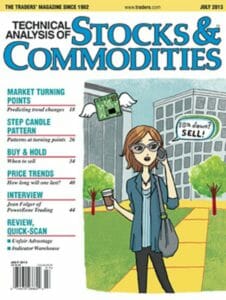
Assuming different technical analysis of stocks and commodities principles are used to trade one over the other is misguided thinking.
For example, you could trade Microsoft stocks and commodities in 3 ways:
1) Microsoft (MSFT) shares outright.
2) Microsoft single-stock futures (http://www.onechicago.com).
3) Microsoft LEAPS® options.
Three ways to trade Microsoft all as a trend follower. Three different instruments created by Wall Street that all relate to Microsoft. A trend follower could choose one to trade or all.
Stocks Like Commodities
Ron Insana of CNBC: With all the market’s recent ups and downs, we thought we’d get the perspective of one of Wall Street’s biggest stars. Leon Cooperman is a founder and principal of Omega Advisors, an investment partnership managing $2 1/2 billion. And, previously — and this goes some years back — Leon headed investment research at Goldman Sachs. Good to see you. Thanks for coming in tonight. First off, tell us a little bit about today. From your perspective, as having managed money for quite a number of years now, does today represent a real turnaround in the market?
Leon Cooperman: I think it’s much too early to tell. I think all we’ve learned is what we already knew, is that stocks have become like commodities, regrettably, and they go up to limit and they go down to limit. And we’ve also known over the years that when they go down, they go down faster than they go up.
What the Cooperman Quote Confirms
Cooperman’s “regrettably” is revealing. He is a fundamental value investor who has spent his career analyzing businesses, studying earnings, and valuing equities relative to their underlying assets. The observation that stocks have “become like commodities” is, from his perspective, a complaint about irrational price behavior. From a trend follower’s perspective, it is simply an accurate description of how price works in any market.
Price moves up and down. It trends. It reverses. It gaps. Markets that are perceived as “fundamental” — stocks — behave exactly like markets that are perceived as “speculative” — commodities. The notation differs: stocks have ticker symbols and share counts, commodities have contract months and delivery specifications. The underlying price dynamics are identical because both are driven by the same human psychology responding to the same uncertainty about the future.
The three Microsoft instruments illustrate the principle at the instrument level. MSFT shares, MSFT single-stock futures, and MSFT LEAPS all track the same underlying price trend. A trend following system that identifies a breakout in MSFT’s price can express that position through any of the three instruments, choosing based on capital efficiency, liquidity, and the specific risk parameters of the account. The trend is the same. The instrument is the delivery mechanism.
Cooperman’s observation that stocks “go down faster than they go up” is the asymmetric volatility observation that trend following addresses through bidirectional positioning. A long-only equity investor experiences the asymmetry as a disadvantage: the gains accumulate slowly and the losses arrive quickly. A systematic trend following approach that can go both long and short treats the downside volatility as an opportunity equivalent to the upside opportunity. When stocks go down faster than they go up, the short trend following position captures that speed advantage rather than suffering from it.
The critical mistake mentioned at the top of the page — treating stocks and commodities as categorically different for trading purposes — is the same mistake that has led generations of equity investors to believe that fundamental analysis is the appropriate framework for their asset class while technical trend following is the appropriate framework for “speculative” commodity markets. The evidence from 20+ years of systematic trend following across both asset classes does not support this distinction. Price is price. Rules are rules. Markets are markets.
Frequently Asked Questions
Can the same trend following rules work on both stocks and commodities?
Yes. The same entry and exit criteria based on price breakouts and defined lookback periods apply to any market where price is the tradeable variable. The notation differs: stocks use shares and dollar prices, commodities use contract sizes and contract month specifications. The underlying price dynamics are the same because both are driven by human participants responding to uncertainty. A rule that enters on a 20-week high works identically in soybeans and in Microsoft shares.
What are LEAPS options and how do they fit a trend following approach?
LEAPS (Long-Term Equity AnticiPation Securities) are options with expiration dates longer than one year, providing long-term exposure to a stock’s price movement with defined maximum loss equal to the premium paid. For a trend follower, LEAPS provide an instrument with a defined downside and leverage similar to futures, which aligns with the long-options-equivalent payoff structure that Mauboussin and Rulle identified as characteristic of systematic trend following positions.
Why does Cooperman say stocks have “become like commodities”?
He means that stocks now exhibit the sharp directional price movements and limit-up/limit-down behavior traditionally associated with commodity futures, driven by program trading, institutional momentum, and high-frequency activity. From a trend following perspective, this is not a change in market character but a confirmation that price behavior in any liquid market follows the same dynamics regardless of what the underlying instrument represents.
TurtleTrader is Michael Covel’s site. So is TrendFollowing.com.
That’s where you’ll find his trading systems, courses, 1,400+ podcast episodes and much more.