
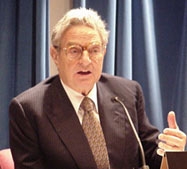
TurtleTrader comment: George Soros, the legendary and enormously successful trader, recently appeared on ABC News Nightline program. The following excerpt of an exchange between George Soros and host Ted Koppel proves illuminating:
Ted Koppel: …as you describe it, it [the market] is, of course, a game in which there are real consequences. When you bet and you win, that’s good for you, it’s bad for those against whom you have bet. There are always losers in this kind of a game.
Soros: No. See, it’s not a zero-sum game. It’s very important to realize…
Ted Koppel: Well, it’s not zero-sum in terms of investors. But, for example, when you bet against the British pound, that was not good for the British economy.
Soros: Well, it happened to be quite good for the British economy. It was not, let’s say, good for the British treasury because they were on the other side of the trade…It’s not — your gain is not necessarily somebody else’s loss.
Ted Koppel: Because — I mean put it in easily understandable terms. I mean if you could have profited by destroying Malaysia’s currency, would you have shrunk from that?
Soros: Not necessarily because that would have been an unintended consequence of my action. And it’s not my job as a participant to calculate the consequences. This is what a market is. That’s the nature of a market. So I’m a participant in the market.
TurtleTrader comment: Why would Soros say trading and speculating are not zero-sum games? Soros is to be saluted for his tremendous success, but he is indeed a speculator participating in a zero-sum game. Perhaps he is reluctant to be as brutally honest with Koppel’s audience as he is with himself. Trading is a zero-sum game when measured relative to underlying fundamental values. No trader can profit without another trader losing.
The Zero-Sum Question in More Depth
Soros’s answer to Koppel is technically defensible in a specific sense. Equity markets are not strictly zero-sum because the underlying companies create real economic value. When a company’s earnings grow, all shareholders benefit without any shareholder losing. The positive-sum element of equity ownership over long periods is real: the aggregate return to equity holders exceeds zero because businesses are genuinely productive.
But Soros was not being asked about long-term equity ownership. He was being asked about his specific trading strategies, which included shorting the British pound and speculating on currency movements. Currency futures markets are zero-sum in the strict sense: for every participant who gains from a currency move, there is a participant on the other side who loses by exactly the same amount. The British treasury’s loss when the pound was forced out of the ERM in 1992 was Soros’s gain. Those two numbers are equal and opposite. That is the definition of zero-sum.
The “not my job to calculate the consequences” answer is the more interesting one. Soros is correctly identifying his role as a market participant rather than a policy maker. A trend follower who is short a declining currency is not responsible for the policy decisions that produced the decline. They are responding to price signals that reflect the policy environment. The consequences of acting on those signals are not their responsibility any more than the dentist is responsible for the sugar industry’s marketing decisions that produced the cavity.
The TurtleTrader comment that Soros is “perhaps reluctant to be as brutally honest with Koppel’s audience as he is with himself” is accurate in this sense: Soros’s public philosophical writing about reflexivity and the imperfections of markets is far more nuanced and honest about the zero-sum dynamics of speculation than the television interview suggests. On television, in front of a mass audience, the zero-sum framing is uncomfortable because it correctly implies that when Soros wins, someone specific loses. He deflected that framing. The deflection is understandable but not entirely honest.
For systematic trend followers, the zero-sum reality is not uncomfortable. It is the structural explanation for why the approach works. The trend follower’s gains come from the hedgers who accept below-market prices for certainty, from the fundamental analysts who hold losing positions waiting for markets to validate their views, and from the buy-and-hold investors who exit at the lows during market crises. All of these participants transfer capital to trend followers in the normal course of their own rational or irrational behavior. Acknowledging the zero-sum nature of the game is not an ethical problem. It is an accurate description of the mechanism.
Frequently Asked Questions
Is trading actually a zero-sum game?
In currency and futures markets, yes. For every gain there is an equal loss on the other side. In equity markets, the long-run answer is more complex because underlying businesses create real value, making equity ownership positive-sum over long periods. But active trading in equities, where gains come from buying and selling rather than from holding through compounding returns, is approximately zero-sum in the short run because trading gains come at the expense of other participants’ trading decisions. Soros’s British pound trade and his Malaysian ringgit positions were zero-sum: his gains were losses for the British Treasury and other currency holders.
Was Soros right that the British pound devaluation was good for the British economy?
In retrospect, broadly yes. Britain’s forced exit from the ERM in September 1992 allowed it to lower interest rates and let the pound depreciate to a competitive level, which contributed to a decade of economic expansion. The short-term political embarrassment for the government was real. The long-term economic outcome was beneficial. Soros’s point about the distinction between the Treasury losing (which it did) and the British economy losing (which it did not, long-term) is accurate, even if it served his rhetorical purpose in the interview.
What does the zero-sum nature of markets mean for trend followers specifically?
It means that trend following returns have identifiable structural sources: hedgers who pay a premium for price certainty, fundamental analysts who hold losing positions too long, and reactionary investors who exit at market lows. These participants transfer capital to systematic trend followers in the normal course of market activity. Understanding the zero-sum mechanism makes the approach’s edge concrete and explainable rather than mysterious. The gains do not come from outcompeting other systematic traders. They come from providing the service that hedgers and behavioral-error-prone investors need and pay for.
Trend Following Systems
Want to learn more and start trading trend following systems? Start here.
