
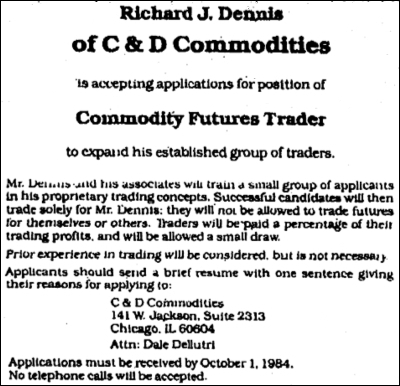
This is one of the famous ads that Richard Dennis used to recruit the Turtles back in the early 1980s:
Why This Ad Changed Trading History
Read the ad carefully. No experience necessary. No educational requirements. No credentials required. A brief resume and one sentence explaining why you are applying. This is not the hiring process for a Wall Street firm. It is the opening move in the most famous nature-versus-nurture experiment in the history of speculative trading.
The background is the debate between Richard Dennis and his partner William Eckhardt about whether trading could be taught. Dennis believed that almost anyone could become a profitable trader with the right training. Eckhardt believed that only natural-born instincts led to success. Dennis ran the ad to find out who was right.
The ad ran in the Wall Street Journal, Barron’s, and the New York Times in late 1983 and again in 1984. Thousands of people applied. Dennis selected 23. He trained them in his trend following system over two weeks in Chicago. He gave them real trading accounts funded with his own money. By the time the experiment ended, the group had generated over $175 million in profits. One person who answered that ad is a billionaire trend following trader today.
The single sentence requirement is worth noting. Dennis was not looking for the most eloquent writers or the most impressive resumes. He was looking for people who could think clearly and directly under a constraint. The person who could say in one sentence why they wanted to trade was demonstrating the kind of direct, uncluttered thinking the system required. The person who needed five paragraphs to answer the question was demonstrating something else.
Dennis’s later comment that “trading was even more teachable than I imagined” is the definitive response to everyone who believes that trading success requires innate talent, years of experience, or special intelligence. The 23 people who answered this ad and were selected proved otherwise. They came from every background imaginable: a professional blackjack player, a pianist, a fantasy game designer, a teacher, a kitchen worker. Two weeks of training and they were managing millions. The rules mattered. The discipline to follow them mattered. The background did not.
Frequently Asked Questions
What was the Richard Dennis Turtle want ad?
A classified advertisement Dennis placed in the Wall Street Journal, Barron’s, and the New York Times in late 1983 and 1984 seeking applicants for a commodity futures trader training program. No prior experience was required. Applicants submitted a brief resume and a single sentence explaining why they wanted to apply. Dennis selected 23 people from thousands of applicants, trained them for two weeks, and gave them real trading accounts funded with his own capital.
Why did the ad say “prior experience in trading not necessary”?
Because Dennis believed that what mattered was not prior experience or innate talent but the ability to learn and follow a systematic approach. His partner Eckhardt disagreed, believing trading required natural instincts that could not be taught. The experiment was designed to settle the debate. The results, $175 million in aggregate profits, settled it in Dennis’s favor.
What happened to the Turtle traders after the experiment?
Many went on to establish highly successful independent trading operations. Jerry Parker of Chesapeake Capital, Paul Rabar of Rabar Market Research, and Liz Cheval of EMC Capital are among the Turtles who became leading commodity trading advisors. Several accumulated substantial personal fortunes. A small number failed to maintain the discipline the system required and did not continue. The divergent outcomes, among people trained identically on the same rules, is one of the most studied questions in trading psychology.
Trend Following Systems
Want to learn more and start trading trend following systems? Start here.
