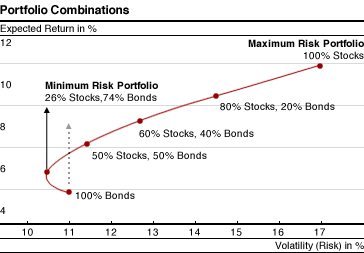
“Including futures in an investment portfolio reduces volatility while enhancing return [and futures portfolios] have substantially less risk at every possible level of return than portfolios of stocks, or stocks and bonds.” — Professor John E. Linter, Harvard Business School.
One would be hard pressed to find a hedge fund prospectus that did not mention Modern Portfolio Theory (MPT). Sure, MPT sounds like an academic ivory tower, but MPT is all about diversification and reducing risk.
Modern portfolio theory is standard practice in the smart investor’s portfolio. MPT places a non-correlated investment, a predefined percentage managed futures component, into a typical bond and equity portfolio. Risk is diversified away from the bond and equity positions into non-correlated managed futures positions. Higher portfolio returns with a reduction in risk is the end result.
The problem with MPT is explaining that you must take on a perceived risky investment (futures for example) to reduce overall risk. That is like saying you must put a foot out of the airplane to be more comfortable. That can be a tough sell to investors not familiar with the benefits of such thoughtful portfolio refinements.
Stocks v. Futures
Stocks and bonds, stocks and bonds. Does mainstream press ever talk of other investments? Today’s self described experts treat stocks as an investment without alternative, yet trading in currency markets dwarfs stock trading. Everyone needs stocks and bonds, but is that enough in today’s global markets?
Contrary to popular opinion, futures markets are more than Las Vegas casinos. Adding futures to your portfolio of stocks and bonds has been shown to be a net plus over the long term. Several studies reveal that a stock and bond investment portfolio with a 10-30% mix of futures over a decade or more increases returns while reducing risk.
Linter’s finding from Harvard deserves direct attention. His research demonstrated that adding futures, typically perceived as the riskiest component of any portfolio, reduces overall portfolio volatility while increasing returns. This counterintuitive result is the mathematical consequence of correlation. When two assets are perfectly correlated, combining them provides no diversification benefit. When two assets are uncorrelated or negatively correlated, combining them reduces portfolio volatility below the volatility of either asset individually, while the combined return is the weighted average of the two. Systematic trend following in futures markets has historically exhibited low and often negative correlation with equity markets during the periods when equity markets fall most severely. That is not a coincidence. It is a structural feature of an approach that profits from large directional moves in either direction, including downward moves in equities during the crises that produce the largest portfolio losses for traditional investors.
The airplane analogy captures the psychological challenge precisely. Putting a foot out of the airplane sounds like increasing danger. But if the foot outside is attached to a parachute, the total system is safer. Adding a futures allocation to a portfolio of stocks and bonds sounds like increasing risk. But if the futures allocation is a systematic trend following component with low correlation to the portfolio’s existing risk, the total portfolio is less risky at the same level of expected return, or more profitable at the same level of risk. The math is unambiguous. The perception is wrong.
The mainstream financial press coverage gap is real. Currency markets in daily turnover dwarf equity markets. Commodity markets, interest rate futures, and global equity index futures represent enormous capital flows that receive a fraction of the media attention that individual stock picking generates. The practical consequence is that most retail investors know nothing about the asset classes where the largest amount of professional capital is deployed and where the systematic trend following edge is most consistently documented. For more on the managed futures landscape and how it fits into a complete portfolio, see the managed futures overview.
Frequently Asked Questions
What is Modern Portfolio Theory and why does it matter for futures investors?
Modern Portfolio Theory, developed by Harry Markowitz, demonstrates that a portfolio’s risk and return characteristics depend not just on the individual assets it contains but on the correlations between those assets. Adding a non-correlated asset to a portfolio reduces overall volatility without proportionally reducing expected return. For futures investors, this means that a managed futures allocation can reduce overall portfolio risk while adding return, even if futures are perceived as individually risky.
Why does adding futures to a stock and bond portfolio reduce risk?
Because systematic futures strategies, particularly trend following, have historically shown low and often negative correlation to equity markets. When equities fall severely, trend following operations are often positioned in the direction of the decline or in other markets that are trending in response to the same events. The combination of assets that move together when times are good and diverge when times are bad provides the diversification benefit that MPT predicts.
What did Professor Linter find about futures in investment portfolios?
Harvard Business School’s Professor John Linter found that including futures in an investment portfolio reduces volatility while enhancing return, and that futures portfolios have substantially less risk at every possible level of return than portfolios of stocks alone, or stocks and bonds combined. His research is one of the foundational academic endorsements of managed futures as a portfolio diversification tool.
Why does the mainstream press ignore futures and focus only on stocks?
Partly because stock market content is more accessible to retail investors who are the primary audience for financial media, and partly because the brokerage industry’s revenue model is built around equity products. Currency and futures markets dwarf equity markets in daily turnover, but they receive a fraction of the media coverage. This creates an information gap that leaves most investors unaware of the largest and most liquid markets in the world.
Want to learn more and start trading trend following systems?
Start here