Pioneer Trend Follower
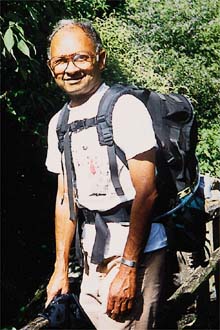
Dinesh Desai
Dinesh Desai was one of the best trend followers in the 1980s before he retired. He made tons of money. He often averaged 80% a year and had some years where he was over 100%. He was real good.
According to Managed Account Reports, the top three funds in 1987 in after-commission performance were:
- Tudor Futures Fund, Tudor Investment Corp., New York, +201.1%.
- North American Commodity Fund I, Desai & Co., Mountain View, Calif., +150.6%.
- Palo Alto Futures Fund, Desai & Co., up +140.3%.
Those numbers are not typos. Two of the top three performing funds in 1987, one of the most turbulent years in market history that included the October crash, belonged to Desai & Co. While most investors were wiped out in the crash or scrambling to recover from it, a systematic trend follower in Mountain View, California was producing returns of 150% and 140% after commissions in the same year. That is what a rules-based approach designed to profit from large directional moves, in either direction, looks like in practice.
Desai, a long-term trend follower, ran Mountain View, California-based Desai and Co. from 1973 until his retirement in 1994. At his peak, he had $250 million under management.
Twenty-one years of systematic trend following. $250 million under management at peak. Annual returns averaging 80%, with multiple years above 100%. These are not the numbers of someone who got lucky in a bull market. They are the numbers of someone who built and operated a disciplined, rules-based system across two full decades of varying market conditions, including the 1987 crash that destroyed countless less disciplined approaches. Desai’s record belongs in the same conversation as the other pioneer systematic traders who defined the industry in the 1970s and 1980s, and his relative obscurity compared to some of those names is itself instructive about how quietly serious money can be made when the focus is on the system rather than on self-promotion. For more on the broader family of systematic trend followers from this era, see the trend following overview and the TurtleTrader story.
Life After Trading
Today, Desai focuses on different kinds of peaks: mountain peaks. He is now an avid mountain climber and outdoor adventurer. Among his achievements, 59-year-old Desai walked the 1,100 mile California coastline, from Oregon to Mexico. He once went with three others on a 200-mile hike in Death Valley, during July, when temperatures hit global highs. He says he survived by drinking three gallons of water a day, and by carrying a reflective umbrella fashioned with an aluminum space blanket to deflect the radiated heat.
Desai tries to concoct some sort of creative adventure every year. Past excursions have included travel to the world’s wettest spot, in India (2001); kayaking 110 miles around the Salton Sea (2000); hiking all 450 miles of the Bay Area Ridge Trail route (1999), and hiking 180 miles of Death Valley in July (1998).
Desai emigrated from the Indian city of Gujarat in 1960.
The same qualities that made Desai a great trend follower, the willingness to commit fully to a chosen path, the discipline to endure hardship without abandoning the plan, and the physical and mental toughness to follow through on objectives that most people would find impossible, show up in the post-trading adventures as clearly as they did in the trading room. A 200-mile Death Valley hike in July, drinking three gallons of water a day and constructing a space blanket umbrella to survive the heat, is not the behavior of someone who quits when conditions get difficult. Neither is holding a short position through a losing stretch because the rules say the trend is still intact. The same character that built a two-decade trading record built the hiking record.
Why Dinesh Desai? Why not? He proves clearly hard work and belief in trend following can win big.
Frequently Asked Questions
Who is Dinesh Desai and what did he achieve as a trader?
Dinesh Desai was a pioneering systematic trend follower who ran Desai & Co. in Mountain View, California from 1973 to 1994. He averaged approximately 80% annual returns, with some years exceeding 100%. At his peak he managed $250 million. In 1987, his North American Commodity Fund I and Palo Alto Futures Fund ranked second and third among all funds globally in after-commission performance, returning 150.6% and 140.3% respectively in the year of the October crash.
How did Desai achieve such strong returns in 1987, the year of the market crash?
By running a systematic trend following approach that was designed to profit from large directional moves in either direction. The 1987 crash was exactly the type of large, sustained directional move that a well-designed trend following system captures. While buy-and-hold investors were devastated by the October decline, systematic trend followers positioned on the short side captured the move as a profit.
What did Desai do after retiring from trading?
He became an avid outdoor adventurer and mountain climber. His post-retirement achievements include walking the 1,100-mile California coastline, kayaking 110 miles around the Salton Sea, hiking all 450 miles of the Bay Area Ridge Trail, and completing multiple Death Valley hikes in July including a 200-mile trek in extreme heat.
Want to learn more and start trading trend following systems?
Start here