
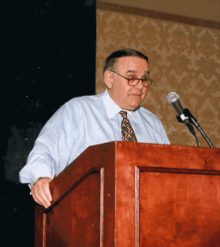
Leon Cooperman built one of Wall Street’s most respected careers across more than five decades, first at Goldman Sachs where he rose to Chairman and CEO of the asset management division, then as founder of Omega Advisors, the $3.5 billion hedge fund he ran from New York. His perspective on markets carries the weight of someone who has seen multiple full cycles of boom, bust, and recovery at the highest levels of institutional finance.
Ron Insana of CNBC Interviews Cooperman
Ron Insana of CNBC: With all the market’s recent ups and downs, we thought we’d get the perspective of one of Wall Street’s biggest stars. Leon Cooperman is a founder and principal of Omega Advisors, an investment partnership managing $2½ billion. And, previously — and this goes some years back — Leon headed investment research at Goldman Sachs. Good to see you. Thanks for coming in tonight. First off, tell us a little bit about today. From your perspective, as having managed money for quite a number of years now, does today represent a real turnaround in the market?
Leon Cooperman (Omega Advisors): I think it’s much too early to tell. I think all we’ve learned is what we already knew, is that stocks have become like commodities, regrettably, and they go up to limit and they go down to limit. And we’ve also known over the years that when they go down, they go down faster than they go up.
Why This Observation Matters for Trend Followers
Cooperman’s comment that stocks have become like commodities, going up to limit and down to limit, and that they go down faster than they go up, is a description of the market behavior that trend following is built to exploit. Asymmetric price movement, where declines are faster and more violent than advances, creates opportunities in both directions for a system that can go short as readily as it goes long.
The observation that it is “much too early to tell” whether a market move represents a genuine turnaround is also central to trend following philosophy. Trend followers do not call bottoms or tops. They do not declare turning points. They read price action and follow it. When a sustained trend emerges in either direction, the system is positioned to capture it. When the direction is unclear, the system waits. “Much too early to tell” is the correct answer to any question about whether a market has turned. The price will tell you when enough evidence has accumulated. The rules define what that evidence looks like.
Leon Cooperman Biography
Leon G. Cooperman founded Omega Advisors, Inc., a $3.5 billion hedge fund based in New York City. Prior to starting Omega, Mr. Cooperman spent 25 years at Goldman, Sachs & Co., where he was a General Partner, and Chairman and Chief Executive Officer of Goldman’s Asset Management division. Mr. Cooperman received his MBA from Columbia University and his undergraduate degree from Hunter College.
Cooperman’s career trajectory from Goldman research to hedge fund founder represents the path of a fundamental value investor who built his reputation on deep analysis of individual companies and their intrinsic worth. His approach differs from systematic trend following in method but shares the same underlying respect for market reality: price ultimately reflects what participants collectively believe, and that reality cannot be argued with. Whether through fundamental analysis or price-reactive rules, the discipline to acknowledge what the market is saying rather than what you want it to say is the common thread running through every successful trading career at this level. For more on how different approaches to the market intersect at the level of discipline and risk management, see the broader trend following framework.
Frequently Asked Questions
Who is Leon Cooperman?
Leon Cooperman is the founder of Omega Advisors, a New York-based hedge fund that managed up to $3.5 billion at its peak. Before founding Omega, he spent 25 years at Goldman Sachs, rising to General Partner and Chairman and CEO of the asset management division. He received his MBA from Columbia University and is widely regarded as one of Wall Street’s most accomplished fundamental investors.
What did Cooperman mean when he said stocks have become like commodities?
He was describing the increasingly violent, limit-to-limit price movements that characterize modern equity markets, where stocks can move dramatically in both directions in short time periods. This behavior, more associated with commodity futures than traditional equity investing, creates the kind of large directional moves that trend following systems are designed to capture, in whichever direction they occur.
Why does Cooperman say markets go down faster than they go up?
Because fear-driven selling is typically more acute and faster-moving than greed-driven buying. Market declines are characterized by panic, forced liquidations, and margin calls that accelerate price movement to the downside. Advances tend to be more gradual as confidence builds over time. This asymmetry means that short positions in a declining market can produce faster returns than equivalent long positions in an advancing one, which is one reason trend following systems trade both directions with equal willingness.
Trend Following Systems
Want to learn more and start trading trend following systems? Start here.
