
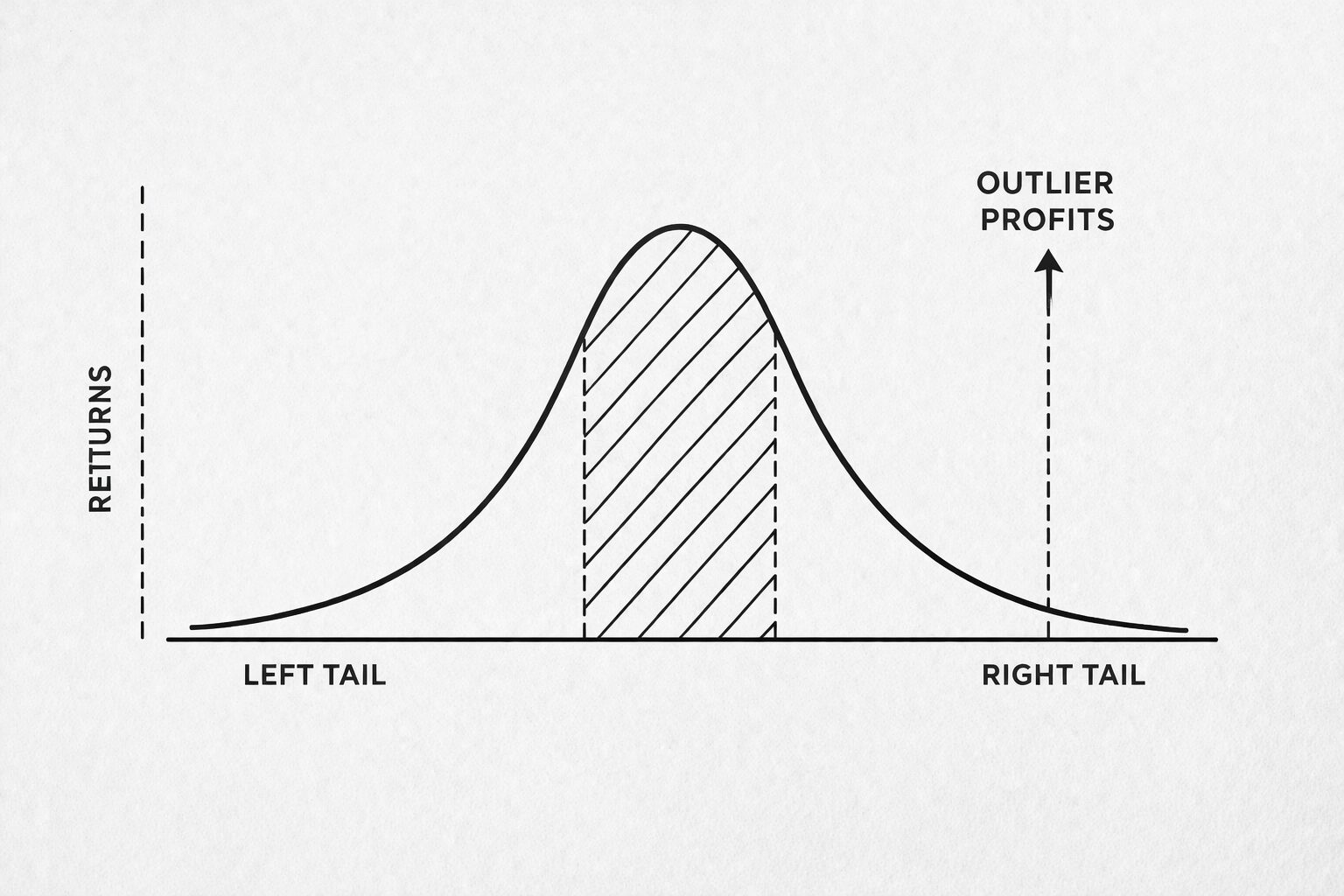
Wall Street is built on the middle. Average returns. Benchmark performance. Consistency. The entire institutional investment industry has been constructed around the centre of the bell curve. And that obsession with averages is the reason trend following has been able to generate extraordinary returns for decades while the establishment watches in confusion.
What the Bell Curve Gets Wrong
The bell curve, or normal distribution, describes a world where most values cluster around a central average, with fewer values appearing toward the outer edges. The financial industry adopted this model because it is convenient. It allows institutions to calculate risk, set portfolio targets, and communicate expected outcomes to clients in a way that feels safe and manageable.
The problem is that markets do not behave this way. Market returns are fat-tailed. Extreme events occur with greater frequency than the bell curve predicts. The 1987 stock market crash, the 2008 financial crisis, and the 2020 pandemic collapse were all, by normal distribution standards, statistical impossibilities. Yet they happened. And they will happen again.
This gap between the model and reality is the most important structural fact about markets for any trend follower to understand. It is not a minor technical footnote. It is the foundation of the entire opportunity.
Why Institutions Cannot Leave the Middle
Large established firms measure their success through central tendency: the mean, the median, the benchmark return. They are bound to the masses who invest with them, and thinking in terms of outliers is not a realistic option. This is not intellectual laziness. It is structural.
The business model of most institutional asset managers depends on accumulating large client capital and charging fees on that capital. To attract and retain clients at scale, the return profile must be smooth, consistent, and comparable to a benchmark clients understand. Trend following is none of those things. It sits flat for months waiting for a move. It produces strings of small losses. It diverges from a stock market benchmark for years at a time.
These characteristics make trend following impossible to package for the risk-averse, benchmark-obsessed middle of the market. And that is the reason the opportunity exists.
The Majority Want Consistency, Not Great Returns
Most investors are comfortable with average returns. Consistency lives in the middle of the bell curve. Of course, this creates the opportunity at the edges.
The average fund investor earns less than the funds they invest in, because they buy after strong performance and sell after drawdowns. They chase comfort and arrive late. This behaviour is deeply human. Our brains seek safety in consensus and interpret short-term pain as a signal that something is broken rather than as the cost of a valid long-term approach.
The will to stick with trend following and stay at the edges of the bell curve is the core of success. The TurtleTrader experiment was, at its core, a test of this question: could people be trained to operate at the edges rather than the middle? Could they accept losses without abandoning the strategy? The answer the results gave was yes.
How Trend Following Exploits the Tails
Trend following is built to profit from outlier events, the fat tails that the bell curve says should be rare but which markets produce with regularity. The strategy accepts many small losses in exchange for occasional large gains. Most trades lose. A smaller number generate moderate gains. A small number generate gains that dwarf everything else.
This return profile is the opposite of what conventional investment offers. A yield-chasing strategy collects small, consistent gains while accumulating hidden tail risk that blows up in a crisis. Trend followers pay the cost of frequent small losses and wait for the large moves that make the strategy profitable over time.
This is why trend following has performed well during the periods when conventional strategies fail most. Major crises produce strong, sustained directional moves in markets. Stocks fall, safe-haven assets rise, currencies collapse, commodities spike. These are the conditions a trend following system is designed to detect and trade. The TurtleTrader rules were built on this foundation.
The Psychological Barrier
Understanding the bell curve argument is one thing. Committing to it for years is another. When trend following goes through an extended drawdown, every human instinct says to stop. The pain of repeated small losses accumulates. The temptation to return to the comfortable middle becomes strong.
This is the moment that separates those who succeed from those who do not. Not intelligence, not superior system design. The ability to remain committed to operating at the edges when every signal is pulling you back toward the middle.
Frequently Asked Questions
What does the bell curve mean for trend following?
The bell curve assumes returns cluster around an average. Trend following rejects this assumption. It is built on the recognition that markets produce extreme moves, fat tails, with greater frequency than the bell curve predicts. Capturing those moves is the entire premise of the strategy.
Why does trend following perform well during market crises?
Crises produce strong, sustained directional moves across markets. Stocks fall, bonds rise, commodities spike, currencies collapse. Trend following systems are designed to detect and trade these directional moves regardless of direction. While conventional portfolios suffer, trend following captures the move in whichever direction the market is heading.
Why do most investors avoid the edges of the bell curve?
Because operating at the edges is uncomfortable and socially difficult to defend. Benchmark-hugging strategies are simple to explain and justify. Trend following requires accepting periods of underperformance, extended drawdowns, and an approach that looks nothing like the mainstream. Most investors and institutions cannot hold that position under pressure.
The TurtleTrader system was designed to live at the edges, not the middle. Read the original TurtleTrader rules
