
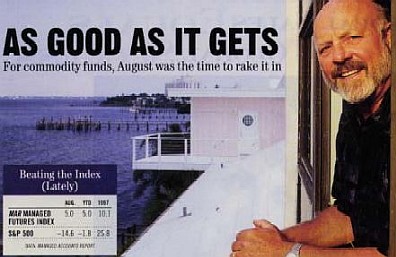
Bill Dunn of Dunn Capital, Business Week 9/14/98, As Good As It Gets, p.190
Trend followers (including turtles) accept a trend as confirmation of direction. Trend followers add to positions aggressively in a systematic manner as long as the trend goes their way. They react to the market. They do not predict.
A buy and hold approach on the other hand may produce profits like in 1995-99, but those so called gains were blown apart in 2000-02. How does one ever exit from a buy and hold strategy? They don’t.
The future is unknown, but if you want to be ready in advance for directional changes, a non-predictive system such as trend following is extremely wise and prudent.
Trend Followers Whip It Up
Bill Dunn of Dunn Capital knows what it is all about:
We don’t make market predictions, we just ride the bucking bronco.
The month of August 1998 killed those long the US stock market. Trend followers, however, made single month killings over many markets going both long and short.
- Abraham Trading (2nd generation Turtle), +23.38%
- Chesapeake, +7.15%
- Dennis Trading Group, +13.50%
- Eckhardt, +31.00%
- Dunn Capital, +27.50%
- Rabar, +19.20%
- Saxon, +50.00%
- John W. Henry, +17.7%
Yes, many firms lost big money in August 98, but those firms were buy and holders, NOT long term trend followers. You ask, “Why is this relevant today?” If you have to ask that question you are in deep trouble!
What August 1998 Proves
The August 1998 results are the clearest available single-month demonstration of what the zero-sum nature of markets means in practice. The firms that lost big in August 1998 were holding long equity positions during the Russian default crisis and the market collapse that followed. The firms that gained were positioned in the direction the market was actually moving, not the direction it had been moving for the previous three years.
The returns in the list span from +7.15% to +50.00% in a single month. These are not modest outperformance numbers. They are absolute gains produced in a month when the S&P 500 fell approximately 15% and hedge funds with long equity exposure suffered catastrophic losses. LTCM was beginning the sequence of losses that would destroy the firm within weeks. The participants who made those August gains were on the other side of those trades.
Dunn’s “bucking bronco” description is the complete methodology statement. The bronco goes where it goes. You ride it rather than steering it. When the bronco throws you, you exit. You do not hold and hope it will stop bucking. The buy-and-hold investor in August 1998 was not riding the bronco. They were holding on to an animal that had reversed direction and hoping it would reverse again. The trend follower exited when the exit rule fired and went short in the new direction.
The buy-and-hold exit question is the most important one in the passage. How does one exit from a buy-and-hold strategy? The theoretical answer is “when the fundamental story changes.” The practical answer, as documented by behavioral finance research on actual investor behavior, is that most buy-and-hold investors exit at the lows during panic, not when the fundamental story changes. They hold through the early decline because they are buy-and-hold investors. They exit at the bottom because the pain becomes intolerable. They miss the recovery. The systematic trend follower exits when the exit rule fires, not when the pain becomes intolerable.
The relevance today is the same as it was in 1998 and the same as it was in 2000-02, in 2008, and in every subsequent crisis. The future is unknown. Directional changes arrive without prior notice. An approach that requires knowing which direction the market will move in order to exit correctly fails at exactly the moments when exiting correctly matters most. A non-predictive systematic approach that reacts to what price is doing handles those moments automatically.
Frequently Asked Questions
Why did trend followers make money in August 1998 when equity markets crashed?
Because systematic trend following can be positioned in any direction and exits positions when the exit rule fires rather than holding through adverse moves. When US equities began declining in August 1998 following the Russian default, trend following systems that were long equities received exit signals and closed those positions. Systems positioned short in the markets that were falling captured the downward moves. The buy-and-hold investor had no exit mechanism and held through the full decline.
What does “we just ride the bucking bronco” mean for trading?
It means the system follows what the market does rather than trying to steer it. A bronco goes where it goes. The rider’s job is to stay on while the direction is favorable and exit when it reverses. Making predictions about where the bronco will go is irrelevant and counterproductive. The systematic trend follower’s job is identical: follow the direction the market is moving, add to the position as long as it continues, and exit when the exit rule fires. No prediction required.
Why can’t buy-and-hold investors exit at the right time?
Because buy-and-hold has no defined exit criteria. The theoretical exit is when the fundamental thesis changes, but markets often move dramatically before the fundamental story acknowledges a change. The practical exit for most buy-and-hold investors is when losses become psychologically intolerable, which is typically at or near the bottom of the decline. The systematic trend follower exits when the price-based exit rule fires, which is early in the decline relative to the buy-and-hold investor’s actual exit point.
Trend Following Systems
Want to learn more and start trading trend following systems? Start here.
