
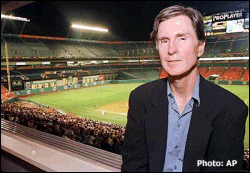
Wisdom from John W. Henry:
I don’t believe that I am the only person who cannot predict future prices. No one consistently can predict anything, especially investors. Prices, not investors, predict the future. Despite this, investors hope or believe that they can predict the future, or someone else can. A lot of them look to you to predict what the next macroeconomic cycle will be. We rely on the fact that other investors are convinced that they can predict the future, and I believe that’s where our profits come from. I believe it’s that simple… when I was designing what turned out to be a trend following system…[that] approach–a mechanical and mathematical system–has not really changed at all. Yet the system continues to be successful today, even though there has been virtually no change to it over the last 18 years.
From The New Investment Superstars:
If one theme summarizes Henry’s philosophy, it is the knowledge that one cannot predict anything. Henry is a long-term follower. His philosophy is based on the premise that market prices, rather than market fundamentals, are the key aggregation of information needed to make investment decisions. He says, The markets are people’s investing expectations, and these [sic] manifest themselves as price trends. We live in an uncertain world. One cannot predict the future of anything. In an uncertain world, identifying and following trends may be the only reasonable investment approach over the long term. Henry feels that a mechanical approach has more value since no scientific approach or solid testing can be applied to discretionary trading. Henry says that when he first researched the markets in the 1970s, he was looking for a methodology that would work through many market conditions. His research showed that long-term approaches work best over decades. There is an overwhelming desire to act in the face of adverse market moves. Usually it is termed ‘avoiding volatility’ with the assumption that volatility is bad. However, I found avoiding volatility really inhibits the ability to stay with the long-term trend. The desire to have close stops to preserve open trade equity has tremendous costs over decades. Long-term systems do not avoid volatility, they patiently sit through it. This reduces the occurrence of being forced out of a position that is in the middle of a long-term major move.
Q&A With John W. Henry
Q. How did you get started in money management, and what advice could you give to someone who would be interested in following in your footsteps?
A. How did I get started? I was hedging crops for farmland that I owned in a couple of states. I just seemed to do fairly well trading by the seat of my pants. It was a broker at Reynolds Securities in those days that asked me if I would manage money for farmers, because I seemed to do so well in the grain markets. That is sort of how it all started. I said no to hedging for farmers. I spent five years working on some ideas I had for trading, and one thing led to another. I came up with a [trend following] philosophy.
From Farming to a Billion-Dollar Trend Following Firm
The origin story Henry tells is one of the most grounded in the trend following literature. He was not a finance professional seeking a systematic edge. He was a farmer hedging his own crops, found he had a natural feel for grain market movements, and was invited by a broker to manage money for other farmers. He declined that specific offer, spent five years developing his ideas in isolation, and emerged with a mechanical trend following system that he ran without material changes for eighteen years.
That durability is the most important detail in the entire profile. Most trading systems are revised on a rolling basis as traders try to improve performance by fitting to recent data. Henry built a system in the 1970s and ran it into the 1990s without significant modification. The system worked because it was built on a principle that does not change: prices trend, and a mechanical approach to following those trends captures a portion of them over time. That principle was as true in the 1970s grain markets as it is in today’s global currency markets. The TurtleTrader rules rest on the same foundation.
The Central Insight: Prediction Is the Problem
Henry’s statement that the profits come from other investors being convinced they can predict the future is one of the sharpest observations in the trend following literature. He is not saying he has superior forecasting ability. He is saying he has no forecasting ability at all, and that this is his edge over investors who believe they do.
The logic runs as follows. Investors who believe they can predict prices make decisions based on those predictions. When the market moves against their prediction, they hold or add to the position because their analysis says they are right. The market forces them out in the end at a much larger loss than if they had followed price. That forced capitulation, repeated across thousands of participants, is what creates the persistent trend patterns that systematic trend followers capture. Henry’s system profits because it follows price rather than prediction. The overconfident investors who hold losing positions create the trends that exit-disciplined traders ride.
Volatility Is Not the Enemy
Henry’s observation that avoiding volatility inhibits the ability to stay with a long-term trend is a precise description of why short-term stop placement destroys long-term trend following returns. A trader who places stops close to entry in order to preserve open trade equity will be stopped out of most major trends during the normal fluctuations that occur within any sustained price move. The trend produces a large gain, but the trader is no longer in it.
Long-term trend following systems sit through that volatility because the system recognises that short-term adverse movement within a larger trend is noise, not signal. Exiting on noise means missing the gains that occur when the signal resolves. Henry found this through years of research in the 1970s. The cost of close stops is measured not in individual trades but in the compounding loss of return over decades of missing the large moves that define the asset class.
Beyond Trading: The Boston Red Sox and Liverpool FC
Henry applied the same analytical rigor he brought to markets to sports ownership. He acquired the Boston Red Sox in 2002 as part of a group, and the franchise won the World Series in 2004, ending an 86-year title drought. The approach his group brought to the Red Sox drew on statistical analysis and evidence-based decision-making, a philosophy that mirrored his approach to markets. He later acquired Liverpool FC in England. Both investments reflected the same belief: that systematic, data-driven analysis produces better outcomes than intuition and conventional wisdom, whether the arena is futures trading or sports management.
More on Henry
Frequently Asked Questions About John W. Henry
Who is John W. Henry?
John W. Henry is a systematic trend following trader who founded John W. Henry and Company (JWH), one of the most successful managed futures firms in history. He began trading in the 1970s while hedging crops on farmland he owned and developed a mechanical trend following system that he ran without significant modification for eighteen years. He later became known as the principal owner of the Boston Red Sox and Liverpool FC.
What is JWH’s trading philosophy?
JWH’s approach is built on the premise that prices, not investors, predict the future. Henry designed a mechanical, mathematical trend following system in the 1970s that captures a portion of price trends across currencies and commodities over time. The system avoids discretionary overrides because no scientific approach can be applied to test discretionary decisions. It treats volatility as an inherent feature of long-term trend following rather than a risk to be avoided.
Why does Henry say profits come from other investors believing they can predict the future?
Because those investors make directional bets based on forecasts rather than price signals. When the market moves against their forecast, they hold or add to positions rather than cutting losses. This creates the persistent price trends that systematic trend followers capture. Henry’s edge is not superior prediction. It is the discipline to follow price rather than forecast, and the patience to hold positions through adverse short-term movements within a larger trend.
How long did Henry run his system without changing it?
Henry stated that his mechanical and mathematical trend following approach had not really changed at all over eighteen years from the time he designed it. That durability reflects the stability of the underlying principle: trends exist across markets and time periods because human behaviour in aggregate is patterned, and a systematic approach to following those trends works across different market conditions.
Trend Following Systems
Want to learn more and start trading trend following systems? Start here.
