
CBS MarketWatch [MKTW] offers daily news and analysis. They also offer technical analysis. Take a look at CBS MarketWatch’s use of predictive technical studies – their version of technical analysis. You can go to CBS MarketWatch, chart a stock and quickly apply a technical study to it. If you want to look at Microsoft with an RSI study no problem. If you want to apply an exponential moving average to Oracle it takes just seconds. Here is a screen shot from CBS MarketWatch so you can see what we’re describing in terms of the layout and example studies applied to a chart:
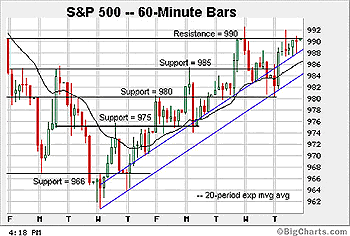
MarketWatch web site states:
The Technical Indicator answers questions that active traders need to know, like: How are the indices positioned going into today’s trading? Is the Volatility Index sending bullish or bearish signals? What does recent market movement suggest for the foreseeable future? What are the near-term support points? Is the market setting up to reach the next higher plateau or is it poised to stumble? When can investors expect a breakout from recent patterns? At what levels are the markets experiencing buy interest?
If you believe this — you better reach for your wallet! Don’t be seduced by claims of prediction.
Avid readers of the TurtleTrader site will instantly see there is NO use of money management at MarketWatch. What CBS MarketWatch offers its readers is a slew of so-called technical studies in an effort to provide buy and sell signals. However, at no time does CBS MarketWatch judge the studies as to whether they are good or bad or even if they have limitations. Since money management is 90% of the trading game, what good can these studies possibly be as indicators of when to buy and sell? Not much.
Most people will never take the time or energy to learn how to trade properly since it is so much easier to be seduced by the ease and comfort of a free charting service or technical study that appears to be credible. However, trading is a zero-sum game and for every winner there is a loser. At TurtleTrader we expect, we even hope that many will continue to stay fixated on the likes of a CBS MarketWatch, Motley Fool, etc. That is fine with trend followers since it makes it that much easier to win losses of people armed with bad plans.
Wisdom to consider from Paul Samuelson:
There is a tempting and fatal fascination in mathematics. Albert Einstein warned against it. He said elegance is for tailors, don’t believe in something because it’s a beautiful formula.
What the MarketWatch Questions Reveal
Read the MarketWatch question list carefully. Every single question asks for a prediction. How are indices positioned? What does recent movement suggest for the foreseeable future? Is the market poised to stumble? When can investors expect a breakout? At what levels are markets experiencing buy interest?
None of these questions have reliable answers. The Volatility Index does not reliably send bullish or bearish signals. Recent market movement does not reliably predict the foreseeable future. Whether the market is poised to stumble or reach the next plateau is not knowable in advance. These are the questions that feel like they should have answers because they are the questions people want answered. They do not have reliable answers because markets are not deterministic systems. The service is selling the appearance of answers to questions that cannot be answered.
The critical absence is precisely what the page identifies: money management. The MarketWatch technical studies produce signals. They do not tell the user how much to buy, where to put the stop loss, how to size the position relative to account equity and market volatility, or when to exit a profitable position. The signal addresses one out of five required components of a complete trading system. The other four — which determine 90% of whether the trading produces profits — are entirely absent.
Samuelson’s warning through Einstein is the appropriate philosophical frame. The MarketWatch technical studies are mathematically elegant. RSI has a clean formula. Moving average crossovers are simple to calculate. Fibonacci levels produce precise numbers. The elegance is for tailors. The trading results are not determined by the elegance of the formula but by whether the formula produces a reliable, testable edge in real market conditions. The formula that looks compelling on a chart and feels sophisticated is not the same as the formula that produces a documented audited track record over 20 years.
The zero-sum observation is the honest statement of what the persistence of prediction-based technical analysis means for systematic trend followers. The money that flows from investors armed with bad plans to traders armed with good plans is what funds the documented returns of systematic trend following managers. Every CBS MarketWatch subscriber who acts on RSI signals without a complete trading system is contributing to the pool from which systematic traders draw profits. At TurtleTrader we genuinely hope this behavior continues, because it is the structural source of trend following’s persistent edge.
Frequently Asked Questions
Why are MarketWatch’s technical indicator questions unanswerable?
Because they are all requests for predictions about an uncertain future. Markets are not deterministic systems. The Volatility Index does not reliably predict directional outcomes. Recent movement does not reliably predict future movement in the specific timeframes retail traders care about. Questions that ask what markets will do in the foreseeable future cannot be reliably answered because the future is genuinely uncertain. A service that presents these questions as answerable is selling false confidence.
What is missing from MarketWatch’s technical analysis?
Money management: how much to buy, where to place the stop loss, how to size the position relative to current account equity and market volatility, and when to exit a profitable position. The technical studies address only the entry signal, which is one of five required components of a complete trading system. The components that determine 90% of trading outcomes are entirely absent from the service.
What does Samuelson’s Einstein quote mean for technical indicators?
That a formula’s mathematical elegance is independent of its trading validity. An indicator that looks sophisticated and produces precise signals does not necessarily produce a reliable trading edge. The RSI formula is clean and computable. That does not mean RSI signals have documented predictive power over market prices. The test of a trading tool is its audited performance in live markets over a sufficient sample, not the elegance of its mathematical construction.
Trend Following Systems
Want to learn more and start trading trend following systems? Start here.
