Defined
“Just what is correlation, and how do we derive the correlation coefficient? Correlation is a statistical term giving the strength of linear relationship between two random variables. More simply defined, it is the historical tendency of one thing to move in tandem with another. The correlation coefficient can be a number from -1 to +1, with -1 being the perfectly opposite behavior of two investments (e.g., up 5% every time the other is down 5%), and +1 reflecting identical investment results (up or down the same amount each period). The further away from +1 you get (and thus closer to -1), the better a diversifier one investment is for the other. Correlation coefficient is found by taking the covariance between two variables and dividing by the square root of the product of each of the two variances (trust us on this part). No wonder the eyes of so many glaze over when discussing the topic of correlation. However, it has some very tangible uses, if they can be explained to the novice. The most simplistic description of correlation is the tendency for one investment to “zig” while others are “zagging”.”
John W. Henry Marketing Materials
Correlation Pairs
Example Correlation Matrix (2003)
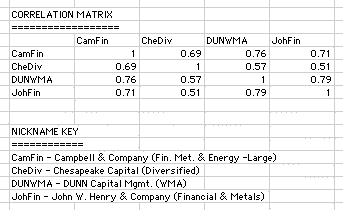
Example Correlation Matrix (2000)
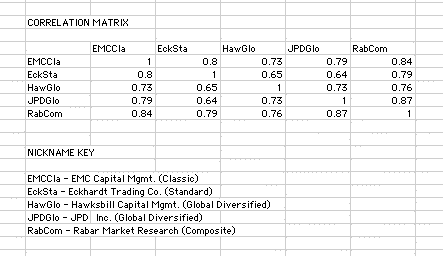
Example Correlation Matrix (1999)
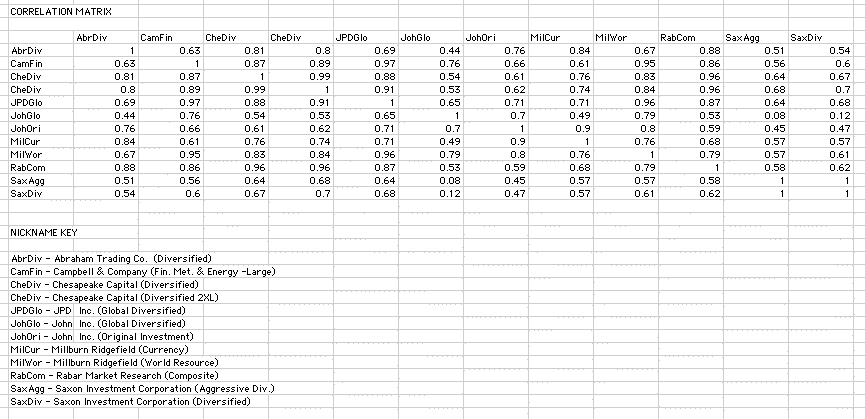
The following table details correlation coefficients among trend followers. These traders make and lose money at the same time in the same markets. What does that say about their trading styles?
| Trading Pair | 07/91-06/95 | 01/95-01/98 |
| Abraham Trading / Campbell | 0.65 | 0.73 |
| Abraham Trading / Chesapeake | 0.71 | 0.83 |
| Abraham Trading / Eckhardt | 0.65 | 0.74 |
| Abraham Trading / Rabar | 0.68 | 0.77 |
| Abraham Trading / Saxon | 0.52 | 0.74 |
| Rabar / Saxon | 0.58 | 0.66 |
| Rabar / JPD | 0.94 | 0.94 |
| Rabar / Hawksbill | 0.75 | 0.70 |
| Rabar / Eckhardt | 0.76 | 0.76 |
| Rabar / Chesapeake | 0.72 | 0.70 |
| Chesapeake / Eckhardt | 0.61 | 0.74 |
| Chesapeake / Hawksbill | 0.62 | 0.66 |
| Chesapeake / JPD | 0.71 | 0.79 |
| Chesapeake / Campbell | 0.65 | 0.67 |
| Chesapeake / John W. Henry | 0.71 | 0.62 |
| Mark Walsh / Chesapeake | 0.54 | 0.80 |
| Mark Walsh / Eckhardt | 0.73 | 0.80 |
| Mark Walsh / Saxon | 0.44 | 0.74 |
| Mark Walsh / Hawksbill | 0.62 | 0.75 |
| Mark Walsh / MC Futures | 0.67 | 0.66 |
| Eckhardt / Hawksbill | 0.75 | 0.64 |
| Eckhardt / Saxon | 0.29 | 0.71 |
| Saxon / Hawksbill | 0.41 | 0.68 |
| JPD / MC Futures | 0.72 | 0.62 |
| JPD / Eckhardt | 0.70 | 0.79 |
| JPD / Saxon | 0.62 | 0.72 |
| Millburn Ridgefield / Chesapeake | 0.61 | 0.65 |
| Millburn Ridgefield / Campbell | 0.75 | 0.76 |
| Millburn Ridgefield / Dunn Capital | 0.76 | 0.71 |
| Dunn / Chesapeake | 0.62 | 0.62 |
Correlation coefficients gauge how closely an advisor’s performance resembles another advisor. Values exceeding 0.66 may be viewed as having significant positive performance correlation. And consequently, values exceeding -0.66 may be viewed as having significant negative performance correlation.
What the Table Reveals
The question at the bottom of the table is the most important one on the page: these traders make and lose money at the same time in the same markets. What does that say about their trading styles?
It says they are all doing essentially the same thing. The individual firms have different names, different headquarters, different research teams, and different specific parameters. But the systematic trend following approach that produces their correlated performance is structurally identical across the group. They all enter when price breaks above a defined level in a defined lookback period. They all exit when price reverses by a defined amount. They all size positions based on volatility. The specific numbers differ. The framework is the same. The correlation table is the proof.
The Rabar / JPD coefficient of 0.94 in both periods is the most striking figure in the table. Two nominally independent systematic trading firms, run by different principals with different research teams and different backgrounds, produced performances that were 94% correlated over multiple years. The most parsimonious explanation is that both were following the same large price trends in the same global markets with similar timing. The correlation is not a coincidence. It is the fingerprint of a shared methodology.
The investor implications are direct. Allocating capital to two highly correlated trend following managers does not produce the diversification benefit that allocating to two uncorrelated managers would produce. An investor who holds Rabar and JPD side by side has approximately the same market exposure as holding one of them at double the allocation. The correlation table is the data that institutional allocators need to construct genuinely diversified portfolios of systematic managers rather than portfolios that merely appear diversified by manager count.
The correlation between trend following managers and traditional equity and bond portfolios is a separate and more important question for most investors. That correlation is structurally low or negative during the market crises that produce the largest equity losses, because crises produce the large sustained directional moves in currencies, bonds, and commodities that trend following captures. The within-trend-following correlation shown here does not reduce the portfolio diversification benefit of adding trend following to traditional portfolios. It reduces only the diversification benefit of adding multiple trend following managers to a portfolio that already has trend following exposure.
Frequently Asked Questions
Why are trend following managers so highly correlated with each other?
Because they all use structurally similar systematic approaches that respond to the same market signals. When a large trend develops in crude oil, currencies, or bonds, all systematic trend following managers who trade those markets will have entered in the same direction around the same time and will exit around the same time. Their approaches differ in parameters but share the same underlying logic: follow price trends across global markets with defined entry and exit rules. The correlation is the measurable consequence of that shared framework.
What does a correlation coefficient of 0.94 between two trend following managers mean?
It means the two managers produced returns that moved almost identically over the measurement period — 94% of the variation in one was explained by the variation in the other. For an investor, this means holding both provides almost no additional diversification compared to holding one at double the allocation. The managers are different firms with different people, but their systematic approaches produce nearly identical market exposure at the portfolio level.
Does the high correlation among trend following managers reduce their portfolio diversification benefit?
Only relative to each other. The high correlation among trend following managers does not reduce their diversification benefit relative to traditional equity and bond portfolios, because that benefit comes from the low or negative correlation between trend following and traditional assets during market crises. The within-trend-following correlation shown in this table is relevant for investors deciding how many trend following managers to hold, but not for the primary decision of whether to add trend following exposure to a traditional portfolio.
TurtleTrader is Michael Covel’s site. So is TrendFollowing.com.
That’s where you’ll find his trading systems, courses, 1,400+ podcast episodes and much more.