
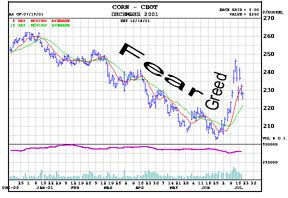
William Landberg’s article appears in the Journal of Accountancy. The Journal is meant for CPAs, but his work must be viewed by all readers:
Read Article: Fear, Greed and the Madness of Markets
Landberg’s article is one of the clearer treatments of how fear and greed produce irrational investor behavior at the exact moments when rational behavior matters most. Published in a journal for accounting professionals, it reaches an audience trained in numerical analysis and financial rigor, yet even that audience needed to be reminded that investor psychology systematically overrides analytical frameworks during market extremes.
The core of Landberg’s argument is familiar to anyone who has studied behavioral finance: fear triggers panic selling at lows and greed triggers speculative buying at highs, both at the precise moments when the rational action is the opposite. The 1987 crash data he cites is the clearest expression of this. When Yale economist Robert Shiller surveyed 900 investors after the October crash, two-thirds attributed the plunge to psychology rather than economic fundamentals. The market did not fall because the underlying economics changed materially overnight. It fell because fear spread, accelerating selling and forcing prices lower independent of any fundamental justification.
This is the environment that trend following operates in. The fear-driven selling produces sustained downtrends. The greed-driven buying produces sustained uptrends. Both are exploitable by a systematic approach that reads price direction and follows it without emotional interference. The trend follower is not immune to fear and greed. They are protected from acting on those emotions by the rules of their system, which define the response to any market condition in advance. For the complete framework, see the trend following overview.
Frequently Asked Questions
What is William Landberg’s main argument in the article?
That fear and greed systematically cause investors to make irrational decisions at market extremes, and that understanding these emotional forces is essential for advisers and investors who want to avoid the behavioral traps that destroy long-run returns. His analysis draws on behavioral finance research to show why panic selling at lows and speculative buying at highs are predictable and recurring features of investor behavior.
Why does the Journal of Accountancy publish articles on investor psychology?
Because CPAs and financial advisers work directly with clients whose investment decisions are driven as much by emotion as by analysis. Understanding how fear and greed distort judgment allows advisers to recognize when clients are about to make emotionally driven mistakes and to intervene with evidence-based perspective rather than simply ratifying whatever the client wants to do.
How does trend following address fear and greed in practice?
By removing the trader from real-time emotional decision-making. Entries, exits, and position sizes are defined by rules built when the trader’s mind was clear and the emotional pressure of a live position was absent. When fear or greed arise during a trade, the rules determine the response, not the emotion. The trader’s job is to execute the rules, not to evaluate whether the current emotional signal is correct.
Trend Following Systems
Want to learn more and start trading trend following systems? Start here.
