Many hear the word correlation and they go to sleep. You can’t sleep though — it’s too important to grasp. Definition:
Correlation coefficients gauge how closely an advisor’s performance resembles another advisor. Values exceeding 0.66 may be viewed as having significant positive performance correlation. And consequently, values exceeding -0.66 may be viewed as having significant negative performance correlation.
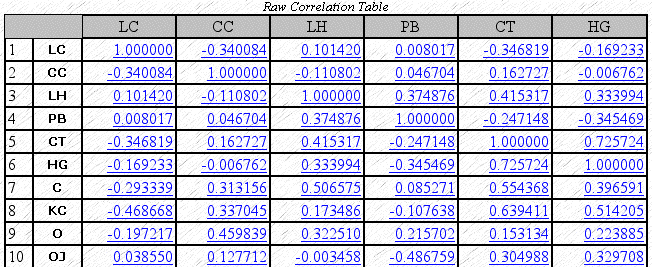
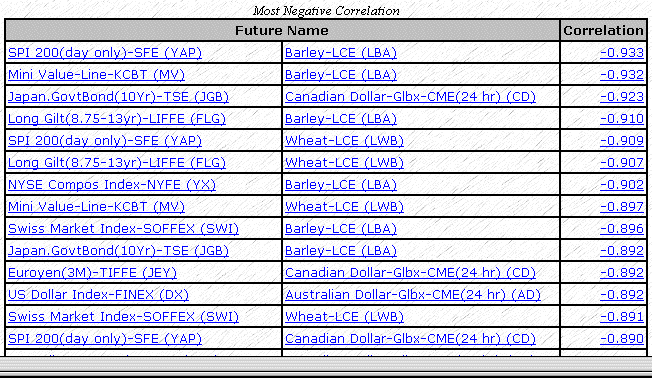
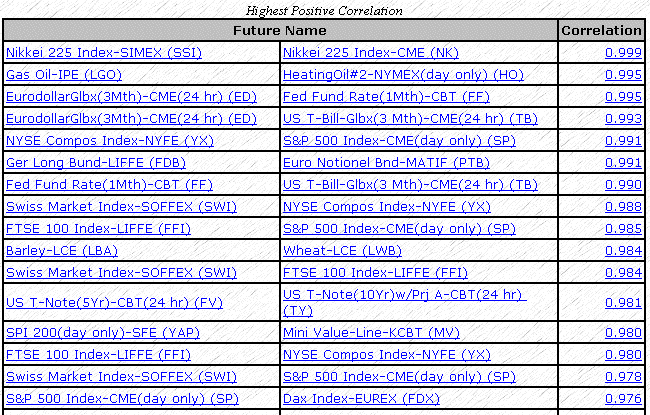
Some examples of correlation in action taken from CSI Data:
Why Useful?
Just what is correlation, and how do we derive the correlation coefficient? Correlation is a statistical term giving the strength of linear relationship between two random variables. More simply defined, it is the historical tendency of one thing to move in tandem with another. The correlation coefficient can be a number from -1 to +1, with -1 being the perfectly opposite behavior of two investments (e.g., up 5% every time the other is down 5%), and +1 reflecting identical investment results (up or down the same amount each period). The further away from +1 you get (and thus closer to -1), the better a diversifier one investment is for the other. Correlation coefficient is found by taking the covariance between two variables and dividing by the square root of the product of each of the two variances (trust us on this part). No wonder the eyes of so many glaze over when discussing the topic of correlation. However, it has some very tangible uses, if they can be explained to the novice. The most simplistic description of correlation is the tendency for one investment to “zig” while others are “zagging.”
How Correlation Shapes the Trend Following Portfolio
The zig-while-others-zag description is simple and correct, but the practical application goes deeper than the definition suggests. A portfolio of positions that are all highly correlated is not really a diversified portfolio regardless of how many positions it contains. Five long positions in energy futures are not five independent bets. They are one bet on energy prices expressed through five instruments. If energy prices fall, all five positions lose simultaneously. The capital at risk is not the sum of five small position sizes. It is the capital that five correlated positions can lose together.
The 0.66 threshold for significant positive correlation is the working standard in the correlation table on the main TurtleTrader correlation page. When two managers have a correlation above 0.66, their performance is moving together substantially enough that holding both provides limited additional diversification beyond holding one at larger size. The Rabar/JPD correlation of 0.94 documented in that table is the extreme example: two nominally independent systematic managers producing nearly identical performance because they are responding to the same price signals in the same global markets with structurally similar approaches.
Truly diversified trend following portfolios hold positions across market sectors that are structurally uncorrelated: agricultural commodities, metals, energy, interest rates, currencies, and equity indices. These sectors respond to different macro drivers. Agricultural prices are driven by weather and demand cycles. Metals are driven by industrial activity and safe-haven flows. Energy responds to geopolitical events and policy decisions. Interest rates are driven by monetary policy. Currencies respond to relative economic performance and capital flows. Equity indices reflect corporate earnings and risk appetite. When one sector is trending, the others may be flat or trending in a different direction. This is what genuine diversification through low correlation produces: reduced portfolio volatility without sacrificing expected return.
The correlation structure of trend following returns relative to traditional equity portfolios is the most important correlation for institutional investors to understand. During the equity market crises that produce the largest losses for traditional portfolios, systematic trend following has historically produced its best returns because those crises produce the large directional moves in bonds, currencies, and commodities that trend following captures. The within-trend-following correlations in the manager table are high. The trend following-to-equity correlation is low or negative during crises. Both correlations matter. The second one is what makes trend following a genuine portfolio diversifier.
Frequently Asked Questions
What does a correlation coefficient of 0.9 between two investments mean?
It means 90% of the variation in one investment’s returns is explained by the variation in the other’s returns. For portfolio construction purposes, two investments with a 0.9 correlation provide almost no diversification benefit relative to holding one at twice the size. Their returns move together closely enough that the portfolio experiences nearly the same drawdowns and gains regardless of which combination is held.
Why does diversification require low correlation rather than just multiple positions?
Because multiple correlated positions lose simultaneously during adverse market conditions, concentrating the portfolio’s drawdown rather than spreading it. Five highly correlated energy positions lose together when energy prices fall. Five positions in genuinely uncorrelated markets lose independently, so a move against any one position is unlikely to also move against the others. The portfolio’s maximum drawdown is reduced by genuine correlation-based diversification in a way that position count alone cannot achieve.
How do systematic trend followers select markets to achieve genuine diversification?
By selecting markets across sectors that are structurally driven by different macro factors: agricultural commodities, metals, energy, interest rates, currencies, and equity indices. Each sector responds primarily to different macroeconomic drivers, producing returns that are genuinely uncorrelated across the portfolio. Historical correlation data, available from sources like CSI Data, allows traders to measure whether the correlations in their portfolio are within the range that produces meaningful diversification.
Trend Following Systems
Want to learn more and start trading trend following systems? Start here.